
A missing tooth is not just a cosmetic issue. Leave the gap long enough and the neighbouring teeth can drift, chewing can become uneven, and the bone beneath the missing tooth starts to shrink. When patients ask me about dental implants versus bridges, they usually want one simple answer: which is better? The honest answer is that an implant is often the better long-term replacement, but it is not automatically the right treatment for every mouth, budget or travel plan.
For patients considering Turkey, the decision also has a practical complication. An implant usually requires two visits separated by several months. A bridge can often be finished during one trip. That difference matters more than many clinics admit.
Dental implants versus bridges: the practical difference
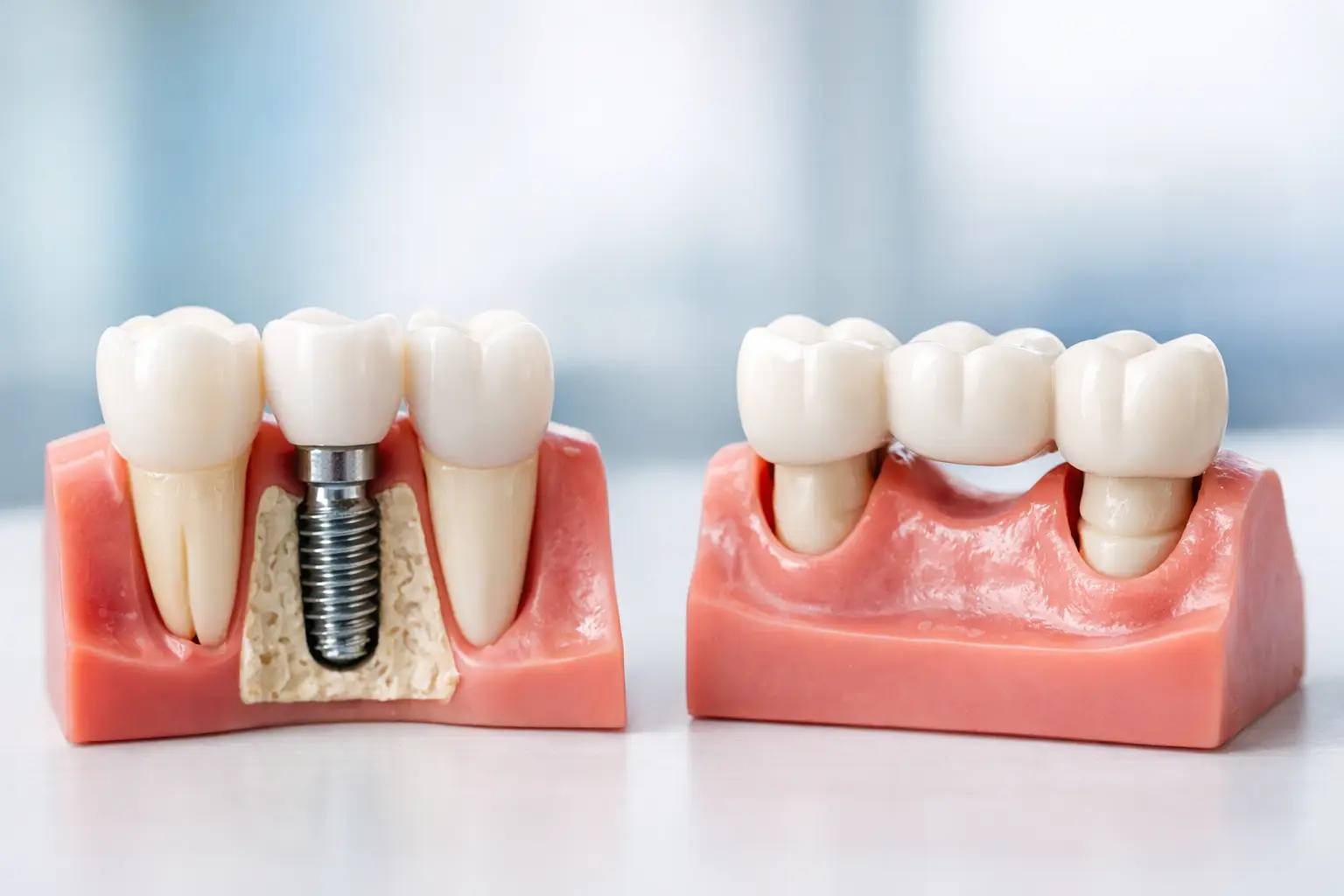
A dental implant replaces the tooth root as well as the visible tooth. A titanium or zirconia post is placed into the jawbone, then left to integrate with the bone before an abutment and crown are fitted. The final result is a standalone replacement tooth. It does not rely on the teeth either side of the gap.
A conventional bridge replaces the visible tooth by attaching a false tooth, called a pontic, to crowns on the neighbouring teeth. To make room for those crowns, the dentist files down the adjacent teeth. A three-unit bridge, for example, commonly replaces one missing tooth using two supporting teeth and one false tooth between them.
That distinction drives nearly every trade-off. An implant preserves neighbouring teeth and helps maintain bone in the gap. A bridge is faster and initially less expensive, but it commits you to altering teeth that may otherwise be healthy.
There is one important exception: a resin-bonded bridge, often called a Maryland bridge. This is usually attached to the back of one neighbouring tooth with minimal preparation. It can be an excellent conservative option for a front tooth, particularly for younger patients who are not yet suitable for an implant. It is not as strong as a conventional bridge, though, and is more likely to come loose.
When an implant is the stronger option
If the teeth beside the gap are healthy, I would generally favour an implant if you have enough bone, good gum health and the patience for the timeline. Filing down two sound teeth to support a bridge is hard to justify when a well-planned implant is feasible.
Implants also tend to make more sense when the missing tooth is towards the back of the mouth. Molars take considerable chewing force, and a single implant crown handles that job without loading neighbouring teeth. A bridge can work perfectly well here, but cleaning under it is harder and the supporting teeth carry more pressure.
Long-term maintenance is another point in favour of implants. The crown on an implant may eventually need replacing, but the implant itself can last decades with good care. There are no nerve-containing supporting teeth under a crown that may later need root canal treatment. That is not a guarantee – implants can fail, and gum disease around implants is real – but the biological logic is sound.
The catch is that implants are surgical treatment. You need sufficient bone volume, stable periodontal health and good daily cleaning habits. Heavy smoking, uncontrolled diabetes, active gum disease and severe teeth grinding can all reduce the odds of success. A responsible dentist assesses these risks rather than selling every missing tooth as an implant case.
When a bridge is the sensible choice
Bridges are sometimes dismissed as an inferior compromise. That is too simplistic. A well-made bridge is a legitimate, proven restoration and may be the most sensible route in several situations.
If the teeth either side of the space already have large fillings, old crowns or cracks, covering them with a bridge may involve little additional sacrifice. In that situation, the bridge can restore three problem teeth in one treatment plan rather than placing an implant and crowning the adjacent teeth separately.
A bridge is also often the realistic option when timing matters. Most overseas implant patients need an initial visit for scans, extraction if required and implant placement, followed by a return visit after roughly three to six months for the final crown. Some cases need longer, especially if bone grafting is involved. A bridge can commonly be planned, prepared and fitted over five to seven days, assuming the supporting teeth and gums are suitable.
I would also consider a bridge when a patient cannot or does not want to undergo surgery. This might be due to medical history, medication, anxiety, limited bone, or simply the fact that two trips to Turkey are not practical. There is no prize for choosing the most technically impressive treatment if it does not fit your life.
Cost in Turkey: compare the full treatment, not the headline price
Turkey can offer a genuine saving, but the cheapest advertised figure tells you almost nothing. An implant quote may refer only to the implant fixture, leaving out the abutment, crown, CT scan, bone grafting, temporary tooth and medication. I have seen clinics advertise an implant at a very low price, then reveal a substantially different total once the patient is in the chair. That is not transparent pricing.
As a broad guide, a single implant with an abutment and quality ceramic crown in Turkey often falls around €650 to €1,250. Complex cases, premium implant systems, bone grafting and specialist surgical care increase the figure. A three-unit bridge may commonly cost around €450 to €1,000, depending on whether it is zirconia, porcelain-fused-to-metal or another material.
Those ranges overlap more than social media adverts suggest. An implant is usually dearer upfront, especially where grafting is needed, but a bridge may need replacement sooner and can create costs for its supporting teeth later. I would not choose an implant solely because someone claims it is ‘for life’, and I would not choose a bridge simply because it looks cheaper on a treatment-plan screenshot.
Ask for an itemised plan showing the exact implant brand, crown material, number of appointments, whether temporaries are included, and what happens if a component fails. If a clinic will not provide this before you travel, treat that as a warning sign.
Lifespan and maintenance are not the same thing
A properly cared-for implant can remain in place for many years, often decades. Its crown, however, is still subject to wear, chipping and replacement. Implants can develop peri-implant mucositis or peri-implantitis if plaque accumulates around them. These are gum and bone problems around the implant, and they are easier to prevent than to treat.
Bridges commonly last roughly 10 to 15 years, sometimes longer. Their main weak points are the margins where crowns meet natural teeth and the supporting teeth beneath. Decay can develop at those margins, particularly when cleaning is poor. If one supporting tooth fails, the entire bridge may need replacing.
Neither option is maintenance-free. With an implant, use interdental brushes or floss designed for the space around the crown and attend hygiene checks. With a bridge, you need to clean underneath the false tooth every day using super floss, floss threaders or an interdental brush. If a clinic says you can treat a bridge like a natural tooth and forget about it, I would not take their aftercare advice seriously.
The travel question clinics tend to gloss over
For a bridge, one Turkey trip is often enough. You should still allow contingency time in case the bite needs adjustment or the laboratory needs a remake. Flying home the morning after fitting is not ideal.
For an implant, be wary of promises of a permanent crown in a few days. Immediate loading can be appropriate in carefully selected cases, but it is not a universal shortcut. Placing an implant into an extraction socket and fitting a temporary tooth is different from declaring the final result complete. Bone needs time to heal around the implant.
A good clinic will tell you whether you need two trips before it takes your deposit. It will also give you records to take home: implant brand, size, batch details where available, radiographs and a written treatment summary. This is essential if you later need care from a dentist in the UK or elsewhere.
How I would make the decision
Start with the condition of the adjacent teeth. Healthy neighbouring teeth point towards an implant. Teeth that already need crowns can make a bridge very reasonable. Then assess bone, gum health, smoking, grinding, medical factors, budget and whether you can return to Turkey for the final stage.
Do not accept a treatment plan based only on photographs or a panoramic X-ray. Implant planning should normally involve a CBCT scan so the clinician can assess bone width, height, nerve position and sinus anatomy. A clinic that offers a fixed implant price before examining these basics is selling certainty it does not have.
The best choice is the one that preserves the most healthy tooth structure while remaining safe, maintainable and realistic for your travel plans. If you are being pushed towards a same-week ‘full solution’ without a proper discussion of those trade-offs, pause before booking the flight.