
A glossy clinic reception tells you almost nothing about infection control. I have seen dental practices with expensive interiors, perfect Instagram feeds and vague answers about how they sterilise instruments. That is exactly why Clinic sterilisation standards Turkey should be part of your research before you compare veneer packages or transfer a deposit.
Sterilisation is not a cosmetic detail. It is the process that protects you from cross-infection between patients. A good Turkish clinic will treat it as a controlled clinical system, not a machine in a back room that gets switched on at the end of the day.
What sterilisation should look like in a Turkish dental clinic
There is no single global rulebook that makes every country’s dental clinics identical. Turkish clinics operate under Turkish health regulations, while many UK readers are familiar with NHS expectations and decontamination guidance such as HTM 01-05. I would not expect a clinic in Istanbul, Antalya or Izmir to use the same paperwork or terminology as a British practice.
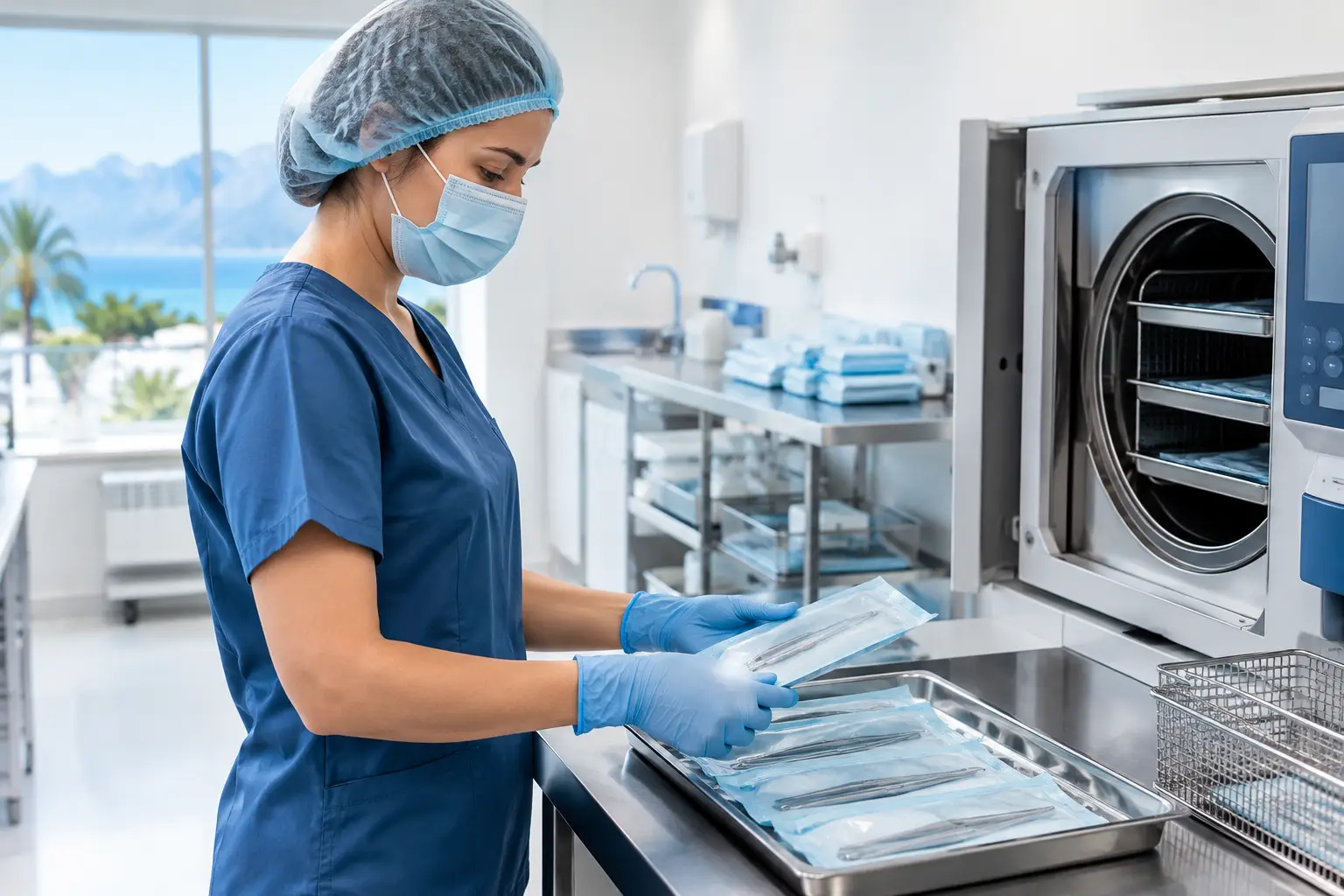
I would, however, expect the underlying process to be equivalent: instruments are cleaned, disinfected, inspected, packaged, steam-sterilised, and stored in a way that keeps them sterile until use. If any stage is skipped or treated casually, the presence of an autoclave alone means very little.
The word “autoclave” gets used freely in dental marketing. What matters is whether it is a suitable vacuum steam steriliser, often referred to as a Class B autoclave, and whether the clinic can show that it is tested and maintained. Class B units are designed to sterilise wrapped, hollow and more complex instruments properly. That is particularly relevant in dentistry, where handpieces and narrow instruments are routine.
A credible sterilisation flow normally looks like this:
- Used instruments are transported safely to a separate decontamination area, rather than being washed beside the dental chair.
- They are cleaned, ideally with an ultrasonic cleaner or washer-disinfector, then inspected for visible debris or damage.
- Instruments are sealed in sterilisation pouches with process indicators and placed through a validated steam cycle.
- The sealed pouches are stored dry and intact, then opened in front of the patient immediately before treatment.
That last point is easy for patients to observe. For fillings, crowns, veneers and surgical work, you should see relevant instruments coming from sealed packs. It is a simple visual check, but it is useful.
Clinic sterilisation standards in Turkey: what to ask before booking
You do not need to interrogate a clinic like an auditor. But you do need answers that go beyond “we follow international standards”. That phrase is a marketing placeholder unless somebody explains what it means in practice.
Ask whether instruments are individually bagged after sterilisation and opened chairside. Ask what type of steriliser is used, how often it is serviced, and whether each cycle is logged. For implant surgery, I would also ask whether surgical kits are sterile-packed separately and whether the clinic uses disposable surgical drapes, suction tips and single-use irrigation materials where appropriate.
A well-run clinic should answer plainly, often with photographs or a short video from its sterilisation room. The response does not need to be polished. In fact, an overly scripted answer can be less reassuring than a straightforward explanation from a treatment coordinator who clearly understands the process.
I would also ask whether handpieces are sterilised between patients. Dental drills are not just wiped down. They should be cleaned, lubricated where required by the manufacturer, and sterilised after each patient. This is basic infection control, yet it is worth asking because some clinics will focus on disposable items while avoiding the more meaningful question.
For more invasive treatment, such as implants, gum surgery or extractions, ask how the clinic prepares the surgery room between patients. Surface disinfection, fresh barrier covers, sterile surgical instruments and appropriate protective equipment all matter. Implant treatment is not automatically unsafe because it is cheaper in Turkey, but it deserves a higher level of scrutiny than a straightforward scale and polish.
What a patient can and cannot verify remotely
Remote checks have limits. A photograph of an autoclave proves that a clinic owns an autoclave. It does not prove it reaches the correct temperature and pressure, completes every cycle correctly, or is regularly tested.
The stronger evidence is a combination of practical details: sterilisation pouches in use, a dedicated clean and dirty workflow, cycle records, service documentation, and staff who can explain the process without dodging. Some larger clinics may be able to share sterilisation monitoring records, although they may reasonably redact patient or internal details.
Be cautious with certificates presented as blanket proof of safety. A clinic may hold a quality certificate, be licensed by the relevant Turkish authorities, or display international accreditation logos. Those things can be positive signs, but none replaces seeing how the clinic actually handles instruments on an ordinary working day.
I would give more weight to consistency. Does the clinic’s explanation match its clinical videos? Are clinicians wearing appropriate PPE? Are disposable items opened when needed? Does the treatment plan allow sensible time between patients, or does the clinic appear to be running a conveyor belt of overseas cases?
Red flags I would not ignore
The clearest red flag is refusal. If a clinic becomes defensive when asked about sterilisation, changes the subject, or says patients should not worry about such details, I would not recommend booking there. Infection control is not a proprietary secret.
Vague answers are another problem. “We use the latest technology” does not answer whether instruments are bagged and cycle-tested. Nor does a claim that the clinic is “European standard”. Ask which parts of its process support that claim.
At the clinic, look for torn or damp sterilisation pouches, instruments left loose on open trays before your appointment, reused disposable suction tips, or staff moving between clean and dirty areas without changing gloves. One isolated imperfection does not always prove an unsafe clinic, but several signs together are enough to pause treatment and ask direct questions.
I am also wary of clinics that schedule major dental work at impossible speed. A fast turnaround can be legitimate when a clinic has an organised lab and enough staff. But excessive patient volume creates pressure on every part of the operation, including cleaning, room turnover and instrument processing. Cheap treatment stops being cheap if standards are compromised.
The trade-off between size, price and confidence
A large dental hospital may have a dedicated sterilisation department, multiple autoclaves and documented workflows. That can be reassuring, particularly for full-mouth rehabilitation or implant cases. The trade-off is that some large clinics feel impersonal, and their sales teams may be more aggressive.
A smaller, clinician-led practice may offer more direct communication and a calmer pace. It can also have excellent infection control. But do not assume a boutique setting means better standards. Ask the same questions, regardless of clinic size or price.
I would not choose a clinic solely because it has the newest scanner, the most followers or the lowest veneer quote. Sterilisation is less glamorous than smile design, which is precisely why weak clinics rarely feature it prominently. The best providers are usually comfortable showing you the unglamorous parts of their operation.
When you arrive, take thirty seconds before treatment begins. Look at the sealed packs, ask where the instruments were sterilised, and pay attention to how staff respond. A good clinic will see an informed patient as sensible, not difficult. That is the standard worth paying for.