
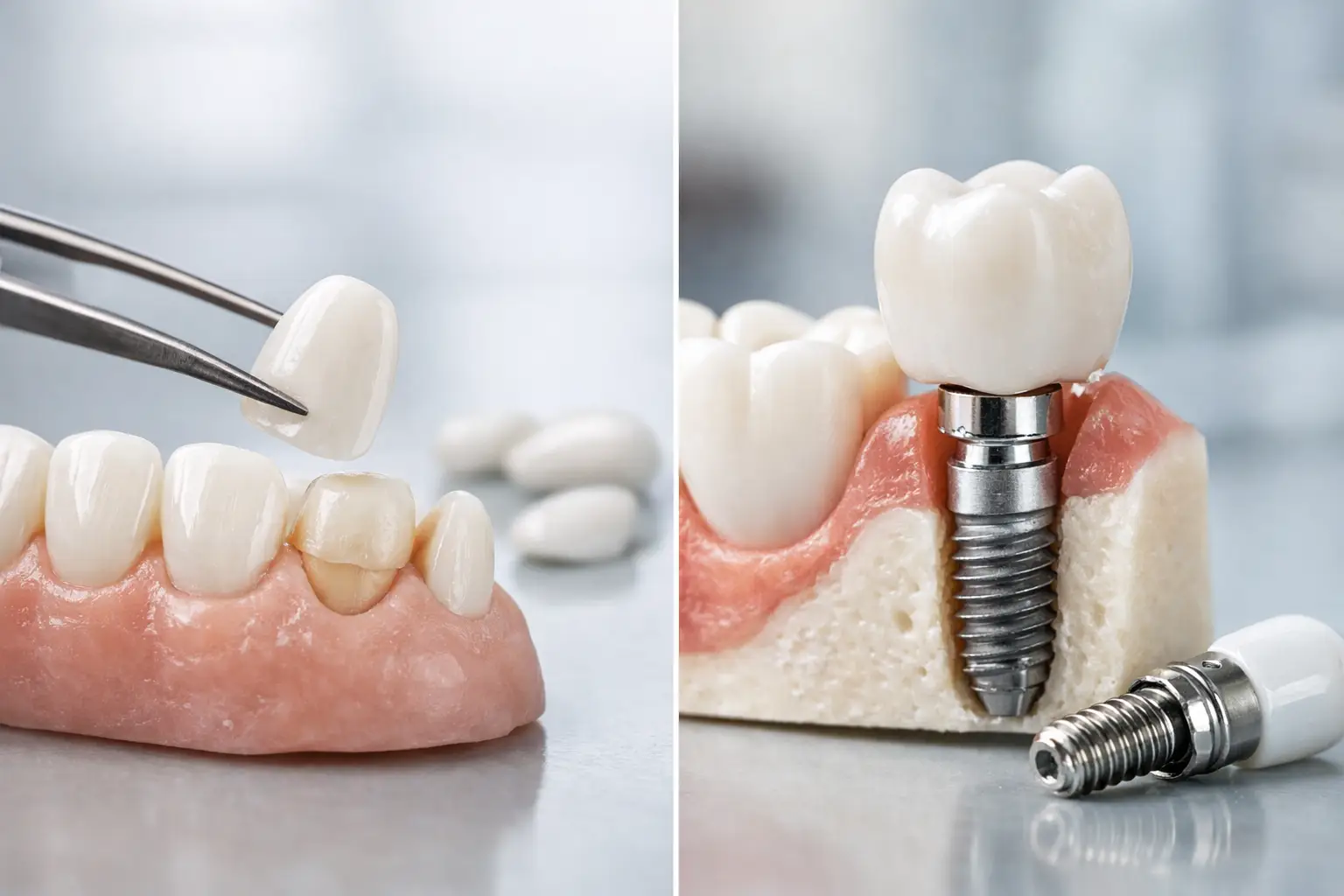
If you are comparing Turkey dental veneers vs implants, you are already asking the right question. Too many patients land in Istanbul or Antalya thinking they are choosing between two cosmetic upgrades, when in reality they are choosing between two completely different treatments with different long-term consequences. I have seen clinics blur that line on purpose, usually because veneers are faster to sell and easier to package.
That is the first thing to get clear. Veneers and implants do not solve the same problem. If a clinic presents them as interchangeable, I would slow down immediately.
Turkey dental veneers vs implants: the core difference
Veneers cover the front surface of existing teeth. They are mainly used to improve shape, colour, minor spacing and small chips. They rely on your natural tooth being present and reasonably healthy underneath.
Implants replace missing teeth, or teeth that cannot be saved. A titanium implant is placed into the jawbone, then restored with a crown after healing. This is not a cosmetic shortcut. It is a surgical treatment used when a tooth is gone or failing.
So the simple version is this: if you still have a healthy tooth, veneers might be an option. If the tooth is missing, or needs extracting, veneers are not even on the table.
That sounds obvious, but it gets muddied in Turkish dental tourism because some clinics market full smile makeovers to patients who actually need a more conservative plan. A lot of people enquire about veneers when what they really need is orthodontics, whitening, bonding or a few crowns. Others are pushed towards extractions and implants far too quickly because implants sound more definitive and bring in more revenue.
When veneers make sense in Turkey
Veneers can be a very good treatment in the right case. If your teeth are structurally sound but stained, slightly uneven, mildly worn or have small gaps, veneers can deliver a strong aesthetic result without replacing the tooth.
In Turkey, veneers are often sold as part of a smile design package. That is not automatically a bad thing. The country has plenty of skilled cosmetic dentists and excellent labs. The problem starts when veneers are used too aggressively.
I would be cautious if a clinic wants to place veneers on every visible tooth without explaining why each one needs treatment. I would also be cautious if they recommend heavy tooth preparation on healthy teeth just to create a more uniform look. Some clinics still sell this as a routine makeover. It is not conservative dentistry.
The better clinics will tell you whether you are suitable for composite bonding, whitening or orthodontics first. If they jump straight to twenty crowns or veneers from a few photos on WhatsApp, that is a red flag.
Veneers are usually quicker than implants. Many international patients can complete treatment in around five to seven days, depending on the plan and whether temporary restorations are needed. Cost is also lower than implants in most cases, especially if multiple teeth are involved.
When implants make sense in Turkey
Implants make sense when a tooth is missing, broken beyond repair, or failing because of infection, fracture or advanced gum disease. In those cases, preserving a dead tooth at any cost is not always the smart move.
Turkey has a strong implant market, with access to reputable implant systems and surgeons who place large volumes each year. But this is where volume cuts both ways. Experience matters, yet high-volume clinics can also become production lines. The best implant result comes from planning, bone assessment, bite analysis and clean surgical protocol – not from doing twelve cases before lunch.
Implants usually require a longer treatment timeline than veneers. Some patients need two trips, especially if bone grafting or healing time is involved. Same-day temporary teeth may be possible in certain full-mouth cases, but the final restoration still takes time. If a clinic tells you implants are always a one-trip solution, that is not the full story.
Cost is higher too. One implant is not just one item on a price list. You may also be paying for extraction, bone grafting, abutments, temporary restorations, CT scans and the final crown. That does not mean Turkey is poor value. It often is far better value than the UK or Ireland. But comparing a veneer price to an implant price without looking at the full treatment plan is meaningless.
Cost: veneers are cheaper upfront, not always cheaper long term
This is where many patients get trapped by headline pricing. Veneers in Turkey are usually cheaper per tooth than implants. That is true. But the better question is what problem you are paying to solve.
If you have healthy teeth and want a cosmetic upgrade, veneers may be the more sensible and more economical route. If you have failing teeth and choose veneers or crowns just to avoid extraction, you may be paying for dentistry that needs replacing again within a few years.
Implants cost more upfront because they are replacing the root as well as the visible tooth. They are a bigger intervention, but often a more durable one when the natural tooth cannot be saved.
I also tell patients to watch for suspiciously low veneer packages. Cheap veneer deals in Turkey often hide one of two things: poor materials or over-preparation. Sometimes both. The clinic gives you a tempting per-tooth price, then turns the case into full crowns because it is quicker and more forgiving for the lab. That is not a veneer treatment in the proper sense.
Aesthetics: veneers usually win on front teeth, if the tooth is healthy
For front-tooth cosmetics, veneers usually produce a more natural result than implants. That is because nothing looks quite like a healthy natural tooth underneath a well-made restoration. Veneers preserve that foundation.
Implants can look excellent, but they are harder to make look perfect in the aesthetic zone, especially if there has been bone loss or gum recession. Matching the gum line around an implant is one of the biggest technical challenges in dentistry. Some clinics advertise implant smile makeovers as if they are straightforward beauty treatments. They are not.
If your front tooth can be saved predictably, I would rarely rush to extract it just because an implant sounds modern. A good natural tooth is still better than a good implant.
Lifespan and maintenance
Neither treatment is forever. Any clinic telling you otherwise is selling, not advising.
Veneers can last many years, but they can chip, debond or need replacement over time, especially if you grind your teeth or have a poor bite. Their lifespan depends heavily on preparation, material choice and how well the case was planned.
Implants can also last a long time, but they are not maintenance-free. Gum inflammation around implants, known as peri-implant disease, is a real issue. Patients often hear that implants cannot get decay and assume that means they are easier to maintain. Wrong. They still need excellent cleaning, regular reviews and a stable bite.
This is why I dislike simplistic claims that implants are permanent and veneers are temporary. Reality is more complicated. The right treatment lasts longer than the wrong treatment, regardless of category.
Which option is safer in Turkish dental tourism?
The safer option is the one that matches your diagnosis. Not the one with better marketing.
For healthy teeth, veneers are usually less invasive than extraction and implant placement. For unsalvageable teeth, implants are usually safer than repeatedly patching a failing situation.
The real risk in Turkey is not veneers versus implants. It is misdiagnosis, overtreatment and rushed planning. I have looked at enough treatment proposals to say this plainly: some clinics prescribe from photos, not from evidence. They promise outcomes before they have seen scans, gum health, bite function or the condition under old restorations.
If you are deciding between these options, ask what you are trying to fix. Stains, shape and small gaps point one way. Missing teeth, severe fractures and non-restorable teeth point another. If the answer is vague, the treatment plan probably is too.
How I would decide
If you have healthy natural teeth and your concern is mainly cosmetic, I would start by asking whether you need veneers at all. Sometimes the right answer is whitening, bonding or orthodontics. If veneers are justified, they should be planned conservatively.
If a tooth is missing or clearly failing, I would ask whether it is restorable. If not, implant treatment may be the stronger long-term option, but only with proper imaging, realistic healing times and a clinic that does not treat surgery like a hotel package add-on.
And if a clinic recommends extracting multiple healthy teeth for implants or heavily cutting down healthy teeth for a quick makeover, I would walk away. There are good dentists in Turkey, but there are also clinics built around speed, not judgement.
The right treatment should feel slightly boring when it is explained properly. Clear diagnosis, sensible trade-offs, no grand promises. That is usually a good sign.