
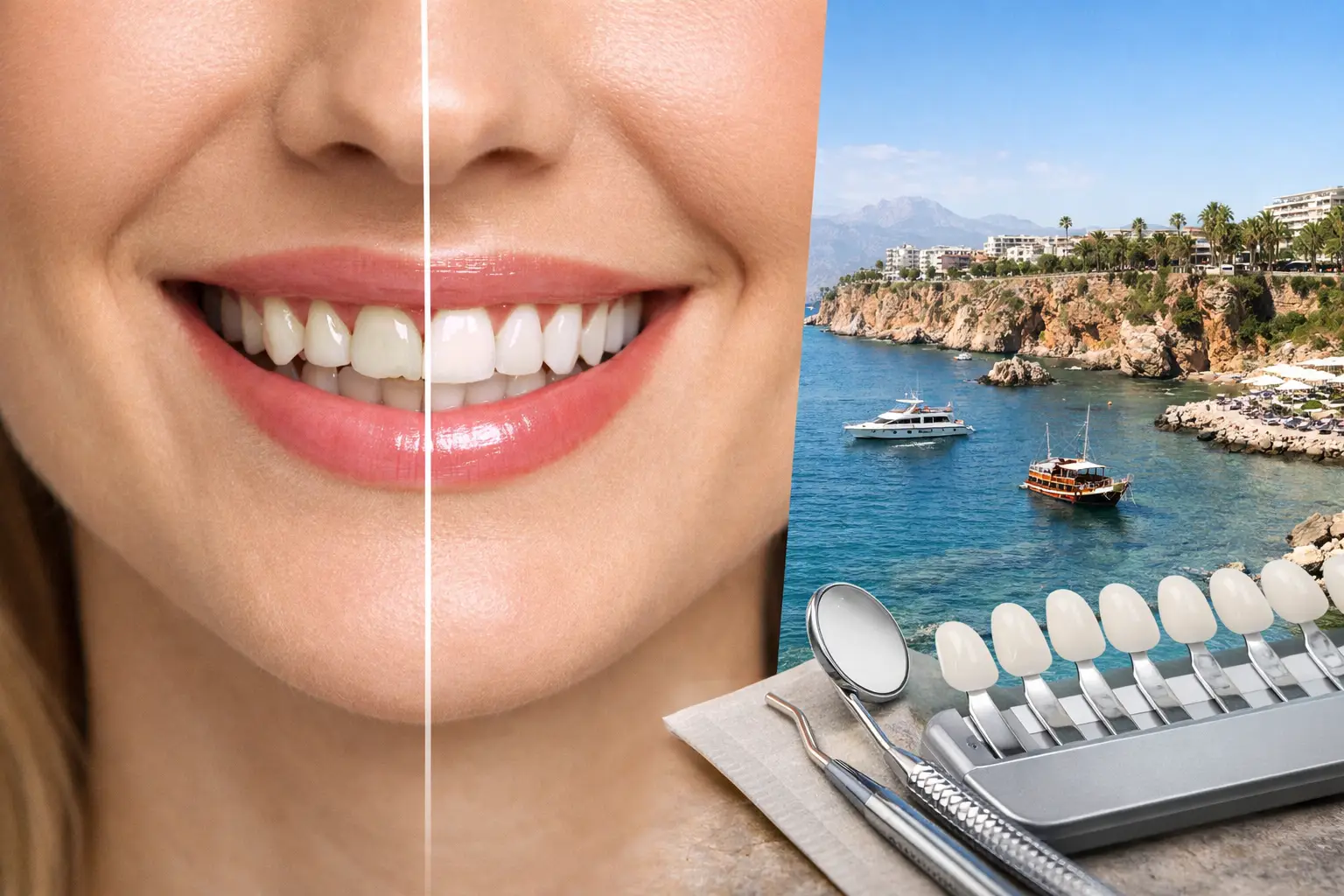
The photos look dramatic for a reason. A patient walks in with stained, uneven or chipped teeth, then walks out a few days later with a bright, symmetrical smile. But when people search for before and after veneers Turkey results, they are usually asking a more useful question: are these transformations actually good, or just good marketing?
I’ve looked at enough clinic galleries to tell you this plainly – many veneer before-and-after cases in Turkey are impressive, but plenty are misleading. Some show genuinely skilled cosmetic work. Others hide aggressive tooth shaving, bulky shapes, poor bite planning, or filters that make average dentistry look exceptional. If you only judge by the final photo, you can get this badly wrong.
What before and after veneers Turkey photos should show
A proper before-and-after set should tell a clinical story, not just sell a fantasy. I want to see the starting point clearly: crowding, old fillings, wear, discolouration, small teeth, gaps, or fractured edges. Then I want to see the finished smile in natural light, from more than one angle, with lips at rest and with a full smile.
If every image is taken under studio lighting with whitening filters and no close-up of the margins, I’m cautious. Good clinics are usually not afraid of detail. Bad ones often avoid it.
The best cases also make sense. If a patient starts with healthy, fairly straight teeth and ends up with twenty ultra-white, oversized units, that is not automatically premium work. It may be over-treatment. Veneers should improve shape, proportion and colour while respecting the face and the remaining tooth structure. A result can look expensive on Instagram and still be poor dentistry.
The biggest mistake patients make when judging veneer results
Most people focus on whiteness and uniformity. I understand why. Those are the most obvious visual changes. But cosmetic dentistry is not a tile showroom. Natural-looking veneers usually have some variation in translucency, edge shape and surface texture.
When every tooth is the same flat block of white, I start asking questions. Did the clinic prioritise speed over custom work? Was the patient pushed towards a shade that will look harsh in daylight? Were crowns used instead of veneers because it was easier for the lab and more profitable for the clinic?
This matters because the real difference between a strong veneer case and a bad one is usually not visible from ten feet away. It’s in the prep, the fit, the bite, and whether the result still makes sense six months later.
Veneers, crowns and the truth behind some transformations
A lot of so-called veneer cases in Turkey are not veneer cases at all. They are full-coverage crowns, often zirconia or E-max crowns, placed on heavily reduced teeth. Clinics know that “veneers” sounds more conservative and more attractive to international patients, so the label gets used loosely.
I wouldn’t treat that as a minor technicality. Veneers and crowns are different treatments. Veneers usually cover the front surface and preserve more tooth tissue, though some reduction is still often needed. Crowns wrap around the whole tooth and require more preparation. If the before-and-after gallery says veneers but the teeth have been shaved down significantly, that is a red flag.
Ask directly what is being fitted. If the answer is vague, or if the clinic uses “laminates”, “veneers” and “crowns” interchangeably, I’d be wary.
What good veneer work in Turkey actually looks like
The strongest before-and-after veneer cases are not always the most dramatic. They are the ones where the final smile suits the patient’s age, face shape, lip line and natural proportions. The teeth look cleaner, brighter and more balanced, but not cartoonishly perfect.
I also look for restraint. Good cosmetic dentists know when not to go too white, too square, or too large. They know that slightly softening a canine or closing a gap by a millimetre can have more impact than rebuilding the whole mouth. That kind of judgement tends to come from experience, not sales scripts.
Turkey does have excellent cosmetic dentists. The problem is that they share the same search results as high-volume clinics turning out copy-paste smile designs. The country is not the issue. Case selection, planning and ethics are.
Red flags in before and after veneers Turkey galleries
Some warning signs show up again and again. The first is every patient ending up with the same smile, regardless of their original teeth or facial features. That usually means templated work.
The second is no view of the gums. Veneers that look decent from the front can still have poor margins or inflamed gum tissue. The third is impossible timelines being presented as routine. Yes, some veneer cases in Turkey are completed within a week. But not every mouth should be. If there is gum disease, unstable bite, untreated decay, or a need for extensive mock-up changes, speed should not be the priority.
Another red flag is before photos with minor cosmetic issues and after photos showing a full arch reconstruction. If the teeth were healthy enough for whitening, bonding or orthodontics, jumping straight to ten or twenty veneers may be excessive. I see this far too often.
Why some before-and-after cases look amazing at first and fail later
The gallery only shows day one. It does not show what happens if veneers are too bulky, if the bite is off, or if margins trap plaque. It definitely does not show what happens when a patient gets home to Manchester, Dublin or Riga and starts noticing sensitivity, speech changes or gum irritation.
This is why I tell readers not to obsess over the finish photo alone. Ask what material was used, how much tooth reduction was required, whether temporaries are placed before final approval, and what happens if you hate the shape. A clinic confident in its process should answer these clearly.
I’d also ask to see healed results or reviews from patients several months on. Fresh cosmetic work often looks its best in the first forty-eight hours. Long-term success is the harder test.
Are the results in Turkey better because the treatment is cheaper?
Not necessarily. Turkey is cheaper than the UK for several structural reasons – labour costs, lab costs, rent and overall operating expenses are lower. That means you can sometimes access a very capable cosmetic dentist for less than you would pay in Britain.
But lower prices do not automatically mean better value. Some clinics keep prices low by rushing prep, using lower-grade labs, delegating too much to inexperienced staff, or pushing every patient into the same package. Others charge premium rates and still deliver average work because they spend more on marketing than dentistry.
So yes, you can get excellent veneers in Turkey at a price that would be hard to match in the UK. But the best before-and-after veneers Turkey cases usually come from clinics that are selective, transparent and not trying to process twenty foreign patients a day.
How to assess a veneer case like a professional
You do not need to be a dentist to judge the basics well. Look at tooth proportions. Do the front teeth dominate too much? Do the side teeth disappear unnaturally? Check the gum line. Does it look even and healthy? Look at the smile in relation to the lips and face. Does it suit the person, or has one generic smile been pasted onto them?
Then ask the less glamorous questions. Were these composite veneers, porcelain veneers or crowns? How many units were placed? Was any orthodontic movement discussed first? Were the lower teeth treated as well, or will they now clash aesthetically with the top arch? Serious clinics can answer this without getting defensive.
If they cannot explain why veneers were chosen over edge bonding, whitening, aligners or a smaller case, I question their judgement.
The trade-off most clinics won’t explain
Patients want dramatic change with minimal drilling, low cost and a five-day turnaround. Sometimes you can get two out of those three. Usually not all three.
If your teeth are heavily rotated, darkly stained, worn down, or filled with old restorations, a conservative veneer approach may have limits. If your teeth are healthy and only mildly uneven, aggressive preparation would be hard to justify. Good treatment planning lives in that tension.
That is the piece missing from many before-and-after galleries. They show transformation, but not the biological cost. I care about the cost to the tooth as much as the cosmetic outcome. You should too.
What I’d do before booking
I’d ask for unedited case photos, confirmation of whether the plan involves veneers or crowns, and a clear explanation of prep levels. I’d also ask who actually does the smile design and whether you get a say before final cementation. If a clinic avoids specifics and keeps steering you back to “Hollywood smile” language, I wouldn’t recommend it.
Dental Guide Turkey exists because too many patients are trying to make permanent treatment decisions based on social media evidence. Before-and-after photos are useful, but only when you read them properly.
A good veneer result in Turkey should look better than your old smile, not less like a real human smile. If a clinic can’t show that difference, keep looking.