
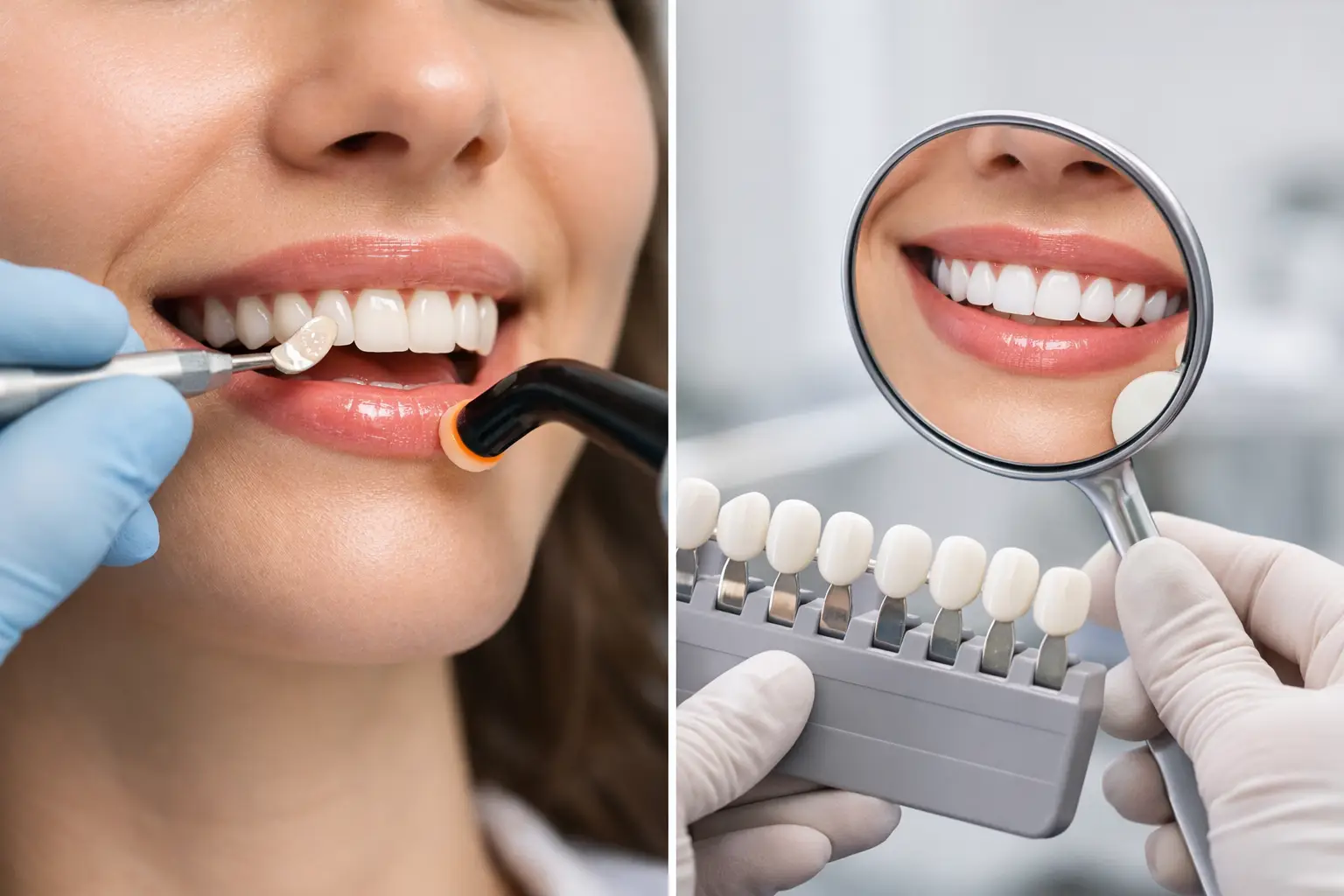
If you are weighing up Turkey composite bonding vs veneers, you are already asking a better question than most patients do. Too many people start with price, then let a clinic sell them whatever has the highest margin. I would do the opposite. Start with how much tooth structure you are willing to alter, how long you want the result to last, and how realistic your expectations are.
This is one of the most common treatment comparisons I see in Turkey, and it is also one of the most badly explained. Some clinics push bonding because it sounds cheap and easy. Others push veneers because they can package them as a full smile makeover. Both can be good treatments. Both can be poor choices if used for the wrong case.
Turkey composite bonding vs veneers – the short answer
Composite bonding is usually the more conservative option. It often needs little to no drilling, costs less upfront, and can work very well for small chips, gaps, worn edges and minor shape corrections. The downside is that it stains more easily, tends to need more maintenance, and usually does not last as long as well-made veneers.
Veneers are usually the stronger and longer-lasting cosmetic option, especially when made from porcelain. They resist staining better and can create a more dramatic change in shape and colour. The trade-off is simple: they are more expensive, they often require irreversible tooth preparation, and bad veneers are much harder to fix than bad bonding.
If a clinic is trying to put veneers on healthy teeth that only need minor cosmetic tweaks, I would treat that as a red flag.
What composite bonding actually suits
Composite bonding is best when the underlying teeth are already reasonably healthy and you are refining rather than rebuilding. Think one or two chipped front teeth, slight unevenness, small spaces, mild wear, or a tooth that needs a bit more symmetry.
In the right hands, bonding can look excellent. The problem is that many clinics in Turkey market it as a quick smile transformation and skip over its limits. Composite is technique-sensitive. If the dentist is rushed or the lab standards are low, you end up with bulky edges, flat-looking surfaces and a result that photographs better than it looks in daylight.
I also think patients underestimate maintenance. Bonding can chip. It can pick up stains from coffee, tea, red wine and smoking. It can usually be repaired, which is a real advantage, but repairs still mean return visits and cost over time.
For younger patients especially, composite often makes more sense than veneers because it preserves more natural tooth.
When veneers are the better option
Veneers make more sense when you need a bigger cosmetic change or want a result with more stability over time. They are commonly used for more significant discolouration, uneven tooth shapes, multiple worn teeth, and cases where composite would be too bulky or too fragile.
In Turkey, most international patients asking about veneers are really asking about porcelain veneers. These are made outside the mouth, usually by a lab, then bonded onto the prepared tooth. Done properly, they can look very natural. Done badly, they look like oversized bathroom tiles.
This is where I become quite blunt. A lot of clinics selling veneers to tourists are not really selling dentistry. They are selling a social media look. Very white, very uniform, very square. If that is what you want, fine. But many patients do not realise how much natural character gets removed in the process.
Once a tooth has been significantly prepared for veneers, there is no going back to the untouched natural tooth. That matters.
Cost in Turkey – where the gap usually is
Composite bonding is usually cheaper per tooth than porcelain veneers in Turkey, sometimes by a wide margin. Exact pricing varies by city, clinic, dentist experience and whether the clinic is targeting local patients or overseas patients. Broadly, bonding can sit in the lower hundreds per tooth, while good porcelain veneers are often several times higher.
That said, the cheapest quote is rarely the smartest one. With bonding, very low pricing can mean rushed work and poor finishing. With veneers, suspiciously cheap pricing can mean low-grade materials, poor bite planning, or aggressive sales tactics designed to get you into the chair before you ask the right questions.
I would also look beyond the initial bill. Bonding often costs less upfront but may need polishing, repair or replacement sooner. Veneers cost more at the start but may offer better value over a longer period if they are well planned and properly fitted.
Tooth preparation – the part clinics often gloss over
This is where the decision becomes serious.
Composite bonding often requires minimal preparation. In some cases, no drilling at all. That is why I see it as the safer default when the cosmetic issue is relatively minor. You keep more of your own enamel, and future options stay open.
Veneers usually involve removing some enamel so the final result does not look bulky. Sometimes the preparation is conservative. Sometimes it is not. The danger in Turkey is that some clinics blur the line between veneers and crowns. Patients think they are getting light-prep veneers and wake up with teeth shaved down far more aggressively than expected.
If a clinic sends you a plan for 20 veneers without clear photos, bite analysis and a proper explanation of preparation levels, I would not trust that plan.
Durability and lifespan
Porcelain veneers generally last longer than composite bonding. With good care, veneers can last 10 to 15 years and sometimes longer. Composite bonding often has a shorter life expectancy, commonly around 4 to 8 years depending on the case, your bite, diet, hygiene and whether you grind your teeth.
But lifespan figures online are often too tidy. Real life is messier. A patient with a heavy bite or untreated grinding can break either treatment. A patient who wants one very minor edge repair may get many good years out of bonding. A patient who wants perfect whiteness with little maintenance may prefer porcelain.
The key difference is not just how long they last. It is how they fail. Bonding tends to chip or stain and can often be repaired directly. Veneers can debond, crack, or fail at the margins, and replacement is usually more complex and more expensive.
Which looks more natural?
It depends far more on the dentist and lab than the label.
Good composite bonding can look beautifully natural, especially for small corrections. Good porcelain veneers can mimic translucency and surface texture better over the long term. Bad versions of either are obvious.
What I see too often in Turkey is clinics showing only ultra-bright before-and-after photos taken under flattering lighting. That tells you almost nothing. I would rather see close-up images, side profiles, gumline detail and cases six months later. If they cannot show that, I assume the finish is not as refined as the Instagram grid suggests.
For patients who want a subtle result, bonding often gives more room for restraint. Veneers can be natural too, but only if the clinic is not chasing the same generic smile on every patient.
Who I think should choose each option
If you have healthy teeth, modest cosmetic concerns, and you care about preserving enamel, I would look at composite bonding first. It is usually the more sensible option for small changes and for patients who are not ready to commit to irreversible treatment.
If you have more significant staining, shape issues across multiple teeth, or you want a longer-lasting cosmetic result and accept the trade-off of preparation, veneers may be the better fit.
What I would not do is choose veneers simply because a package deal makes them look glamorous. And I would not choose bonding purely because it is cheaper if the correction needed is too extensive for composite to hold up well.
The questions worth asking before you book
Ask how much preparation is expected on each tooth. Ask whether the result is additive or subtractive. Ask what material is being used. Ask how repairs are handled if something chips after you return home. Ask to see natural-looking cases, not just bright white ones. Ask whether the dentist doing the work is the same person featured in the marketing.
If the answers are vague, rehearsed, or suspiciously pushy, move on.
A good clinic should be able to explain why bonding is enough, why veneers are justified, or why neither should be rushed until your bite, gum health or alignment is sorted first. That last point matters. Cosmetic work placed on top of untreated functional problems is where expensive dentistry starts to unravel.
If you are still torn between the two, I would keep one principle in mind: the best cosmetic dentistry is usually the least invasive treatment that can realistically deliver the result you want. That standard rules out a lot of bad recommendations very quickly.