
A spotless marble reception tells you almost nothing about infection control. When patients ask me how Turkish clinics manage hygiene, I look past the décor and Instagram content to the systems nobody sees: instrument flow, sterilisation records, treatment-room turnaround and whether staff follow the same rules when no patient is watching.
Turkey has excellent dental clinics with modern equipment and disciplined infection-control teams. It also has high-volume cosmetic clinics where speed can put pressure on standards. The country is not the deciding factor. The individual clinic is. That distinction matters when you are travelling abroad for crowns, veneers, implants or surgery.
How Turkish clinics manage hygiene behind the scenes
A properly run clinic separates contaminated instruments from clean and sterile ones. That sounds obvious, but it is the foundation of safe dentistry. Used handpieces, scalers, forceps and implant instruments should move from the surgery into a designated decontamination area, not get rinsed at a sink beside fresh supplies.
The normal sequence is cleaning, inspection, packaging and steam sterilisation in an autoclave. Cleaning removes visible debris and organic material. Sterilisation then destroys microorganisms, including bacterial spores, under controlled heat and pressure. These are not interchangeable steps. Wiping an instrument with disinfectant is not sterilisation, and I would not accept a clinic that blurs the distinction.
Most reputable Turkish clinics use sealed sterilisation pouches with chemical indicator strips. The pouch should be opened in front of you, or at least placed unopened on the prepared tray before treatment begins. The colour-changing strip is not proof of a perfect cycle by itself, but it is a useful visible check that the pack has gone through a sterilisation process.
Better clinics also maintain autoclave cycle logs, test their machines routinely and track batches of instruments. You may never need to inspect these records, but a clinic should not become defensive if you ask how it monitors sterilisation. A clear answer is reassuring. An evasive answer about “international standards” without describing its actual process is not.
The equipment that should be single-use
Some items should never be reused between patients. Needles, anaesthetic cartridges where applicable, saliva ejectors, surgical blades, suction tips, gloves, masks, bibs and many polishing attachments are single-use. Implant surgery introduces additional disposable items, including sterile drapes, irrigation tubing and surgical suction components.
Gloves are a common point of confusion. Clinicians can wear gloves and still contaminate a clean area by touching a phone, keyboard, drawer handle or door. Watch whether gloves are changed between patients and after handling anything outside the clinical field. It is a small detail, but it reveals whether a team has good habits or merely performs hygiene for the patient.
Dental handpieces, the high-speed drills used for tooth preparation, deserve particular attention. They must be cleaned, lubricated where required and sterilised between patients. They are not simply wiped down. Clinics using disposable or sterile handpiece systems for surgical work may reduce some handling risk, but the wider sterilisation process still matters.
The treatment room is only as clean as its turnover
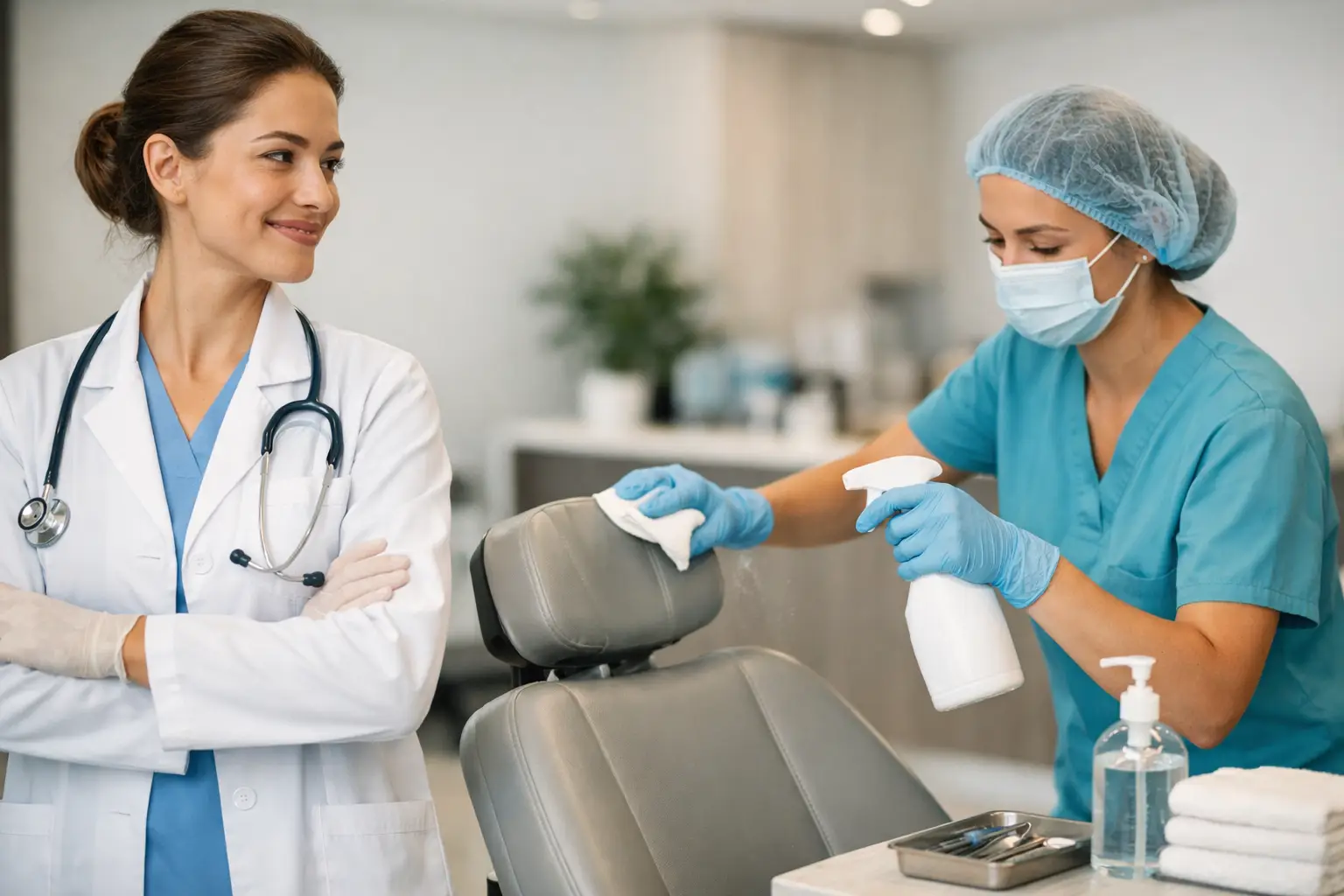
Between patients, staff should disinfect all high-touch surfaces: the dental chair, light handles, worktops, control panels, suction controls and any equipment used during treatment. Protective barrier film is often placed on handles and controls, then removed and replaced after each patient. A good room turnover is methodical, not theatrical.
I would not judge a clinic because a nurse cleans the room quickly. Experienced teams can do it efficiently. I would judge it if the next patient is brought in before the previous tray has been cleared, if visibly used materials remain nearby, or if fresh instruments are sitting loose and uncovered long before the appointment starts.
Air quality is another consideration, especially for treatments that create aerosols, such as drilling, ultrasonic scaling and crown preparation. Many modern clinics use high-volume suction, air purification and ventilation systems. These help reduce airborne contamination, but they do not replace standard cleaning and personal protective equipment. If a clinic sells air purifiers as its main hygiene credential while saying little about sterilisation, it is focusing on the easier marketing story.
Waterlines, laboratories and implants: the less obvious risks
Dental unit waterlines can harbour biofilm if they are poorly maintained. The water used to cool a drill is not necessarily sterile, but clinics should flush lines, use appropriate treatment products and follow maintenance schedules. For routine restorative work, this is usually managed through waterline protocols. For surgical procedures, particularly implant placement, sterile saline irrigation is commonly used where indicated.
You are unlikely to see a waterline maintenance log during a consultation, and I would not expect every patient to ask for one. But it is reasonable to ask what water is used during implant surgery and how the clinic maintains its dental-unit lines. A clinician or treatment coordinator should understand the question rather than treating it as inconvenient.
Laboratory hygiene also matters, although it receives far less attention than the surgery. Impressions, bite records and temporary restorations travel between clinic and lab. They should be disinfected before dispatch and handled with traceable case information. In large Turkish dental centres, the lab may be in-house. That can shorten turnaround times, but it is not automatically better. An in-house lab still needs clean workflows, quality control and proper separation from clinical areas.
For implants, sterile surgical protocols matter more than a glamorous veneer package. The clinician should prepare a surgical field, use sterile instruments and draping where appropriate, and give you clear aftercare instructions. The exact setup varies with the procedure. A straightforward single implant is not the same as full-arch surgery, grafting or sinus lifting. Higher-complexity surgery should mean stricter theatre-style discipline, not just a longer appointment.
What I would ask before booking
You do not need a degree in infection prevention to assess a clinic. Ask direct, specific questions before you pay a deposit. A serious provider can answer them without sending a vague copy-and-paste response.
Ask whether instruments are individually packaged and opened for each patient, how the clinic sterilises handpieces, and whether it keeps autoclave test and cycle records. If you are having implants, ask whether surgical instruments are prepared in sterile packs and whether sterile irrigation is used. You can also ask if the clinic has a dedicated sterilisation room and who is responsible for infection-control oversight.
Photos and videos can help, but treat them cautiously. A picture of an autoclave is not evidence that staff use it correctly. Ask for a short video of the sterilisation area or a clear explanation of the workflow. The response is often more revealing than the footage. Clinics that take safety seriously tend to be proud of the process, not irritated by the question.
Once you arrive, look for sealed packs, fresh barriers on the chair controls, clean working surfaces and staff changing gloves appropriately. Do not expect a hospital operating theatre for a routine filling or crown appointment. Do expect an organised clinical environment where contaminated and sterile items are clearly kept apart.
Red flags I would not ignore
A few lapses can be innocent: a busy room, a tray being prepared out of sight, or a language barrier with a coordinator. Patterns are different. I would pause treatment and ask questions if instruments are loose in drawers, packs look damp or damaged, gloves are used to answer phones, or staff move directly from a previous patient to you without cleaning the chair.
I am equally wary of clinics that promise “100% sterile” care as a marketing slogan. No honest healthcare provider can eliminate every risk. What good clinics do is reduce risk with repeatable procedures, staff training, equipment testing and transparency when something falls outside the norm.
Price can be a clue, though not a verdict. Turkey’s lower operating costs can make treatment genuinely affordable compared with the UK or Ireland. But an implausibly cheap full-mouth package may rely on relentless patient turnover, rushed planning or cuts that are hard for a visitor to spot. Hygiene is not usually listed as a line item on a quotation, yet it is built into the staffing, equipment and time a clinic allows for each case.
The best question is not whether Turkish dentistry is hygienic. It is whether the specific clinic can show you a disciplined system and give you confidence in the people following it. If the answers are vague before you travel, do not assume they will improve once you are in the chair. Choose the clinic that treats your questions as sensible, because they are.