
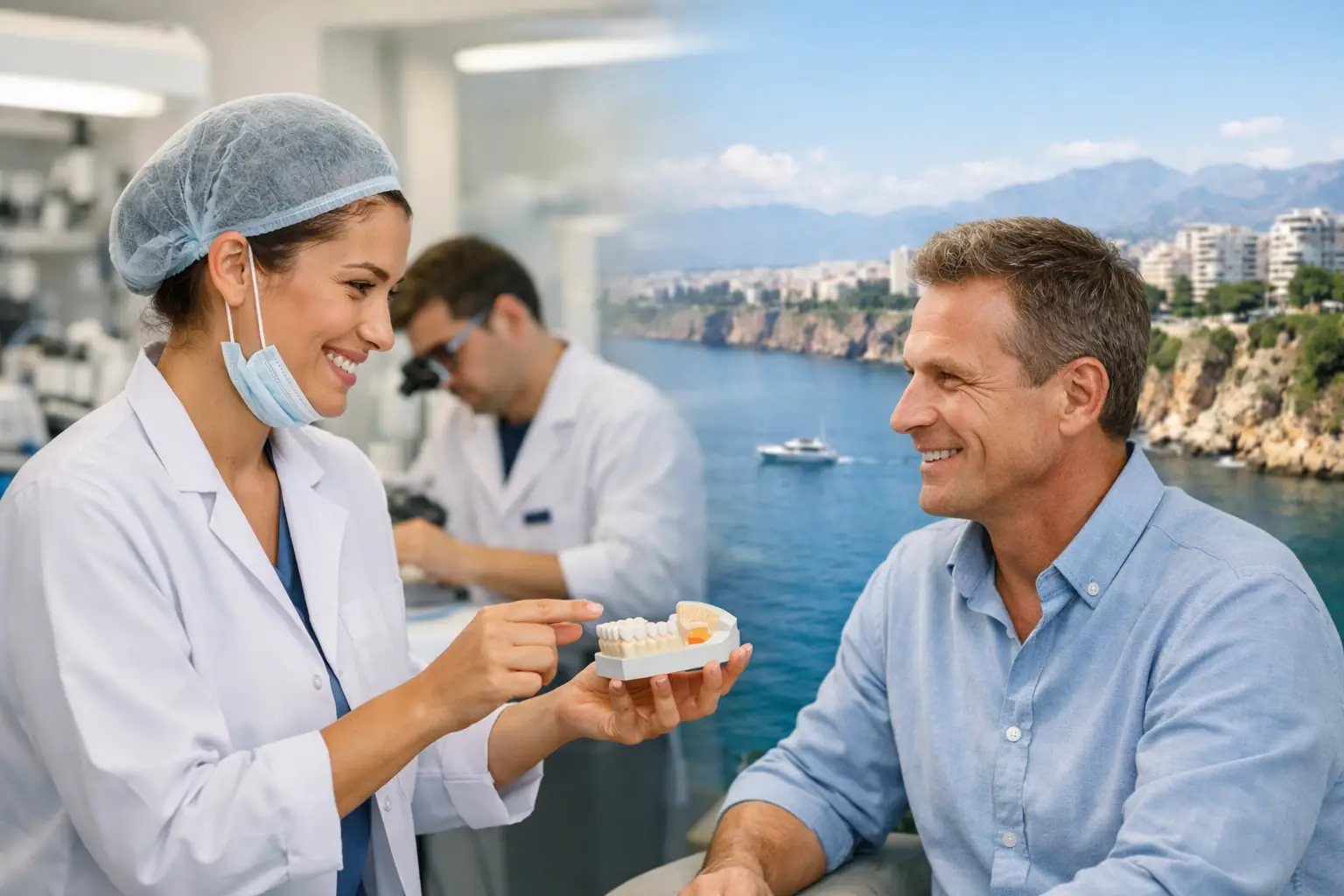
A beautiful clinic tells you very little about the teeth that will eventually be fitted in your mouth. When patients ask me how Turkish dental labs work, that is the point I start with: the laboratory often determines the fit, shape, shade and long-term outcome of crowns, veneers and implant restorations. The dentist prepares the teeth, but the lab manufactures the final work.
Turkey has excellent dental laboratories, particularly in Istanbul, Antalya and Izmir. It also has rushed, high-volume labs producing work for clinics that sell speed above everything else. The difference is not a small technical detail. It is often the difference between natural-looking dentistry that settles well and a smile that looks bulky, opaque or simply does not fit properly.
The relationship between clinic and laboratory
Most international patients never visit the lab. They deal with the clinic, while the dentist sends scans, photos, bite records and instructions to a partner laboratory. Some larger clinic groups have an in-house lab in the same building. Others use a dedicated external lab nearby. A few send complex cases to a specialist lab in another city.
An in-house lab is not automatically better. It can make adjustments faster because the technician and dentist can speak directly and the patient can be recalled for a same-day check. But plenty of external Turkish labs produce excellent work. What matters is whether the dentist gives clear instructions, whether the lab has skilled technicians, and whether there is enough time for proper review.
The problem starts when a clinic treats the lab as a production line. If the sales team promises a full smile in two or three days before anyone has examined your bite, gum health or existing teeth, the laboratory timetable is driving the treatment plan. I would be cautious about that.
How Turkish dental labs work from scan to fitting
For crowns, veneers and bridges, the process normally begins after the dentist has prepared the teeth, or after implant positions have been confirmed. Many modern Turkish clinics use an intraoral scanner rather than conventional putty impressions. The scanner creates a digital model of your teeth, gums and bite, which is sent electronically to the laboratory.
The dentist should also provide photographs, a requested tooth shade, notes on length and shape, and details of your bite. For a front-teeth case, these records matter enormously. A digital scan can show dimensions accurately, but it cannot by itself tell a technician how much tooth display suits your face or whether you show more gum when smiling.
At the lab, a dental technician designs the restoration using CAD software. The design is then milled from a ceramic block or zirconia disc, or occasionally printed as a temporary restoration or model. Zirconia restorations require sintering in a high-temperature furnace after milling. Ceramic work may then be layered, stained and glazed by hand to create depth and translucency.
That final artistic stage is where labs vary sharply. A basic monochromatic zirconia crown can be made quickly. It may be strong, but on front teeth it can look flat or too white. A technician who understands layering, surface texture and natural shade transitions can make a restoration look far less manufactured. This is why material brand names alone do not guarantee a good result.
The finished crowns or veneers return to the clinic for a try-in. The dentist checks the contact points, margins, bite, colour and overall appearance before cementing them. If something is wrong, the work may need polishing, adjustment or a complete remake. With an in-house lab, this can sometimes happen within hours. With an external lab, it may add a day or two.
Materials are only part of the quality question
Patients are often offered Emax, zirconia or a branded ceramic name as if that settles the quality issue. It does not. These materials have different uses, and the same material can be handled brilliantly or badly.
Lithium disilicate, commonly sold under the Emax name, is valued for its lifelike translucency and is often suitable for veneers and many single crowns. Zirconia is highly durable and commonly used for bridges, posterior crowns and implant restorations. Newer multilayer zirconia can look better than older versions, although it still does not suit every cosmetic case.
A good lab needs to use genuine, traceable materials. Ask for the material certificate or warranty document if you are having multiple crowns, veneers or implant work. I would not accept vague answers such as “European ceramic” when the clinic cannot name the manufacturer, product range or laboratory responsible.
Still, material traceability is one check, not the whole check. A perfectly genuine ceramic crown with poor margins, an over-contoured shape or a badly managed bite is not good dentistry.
Why turnaround time matters
Turkey’s dental tourism model is built around short visits. For straightforward crown work, a clinic may plan five to seven days from preparation to final fitting. That can be realistic when the case is properly assessed and the clinic has a capable lab partner. It gives time for temporary teeth, design, manufacture, try-in and corrections.
The trade-off is obvious. The shorter the schedule, the less room there is for changes. A two-visit plan can work well for simple cases with healthy gums and a stable bite. It is less sensible for someone needing bite rehabilitation, extensive gum treatment, implant surgery or a major change in tooth position and smile shape.
Implant restorations need particular caution. An implant crown may be made quickly after an implant has already healed, but the implant itself generally needs months to integrate with the bone before final loading. Any clinic presenting implants and permanent teeth as a universal one-week treatment is simplifying a process that depends on bone quality, stability and whether grafting is needed.
Where quality control should happen
The best results come from repeated checks, not a single final appointment. The dentist should verify that preparations are clean and accessible, the scan captures the margins, and the bite record is reliable. The technician should flag unclear areas rather than guessing. At try-in, the patient should be shown the work before final cementation, especially for visible teeth.
For larger cosmetic cases, I prefer clinics that use a mock-up or temporary trial smile. It lets you test length, bulk, speech and appearance before the laboratory commits to the final ceramic. It adds time and sometimes cost, but it is cheaper than remaking ten front crowns because nobody questioned the design early enough.
A lab should also have a system for checking the internal fit, contact points and surface finish. You will not personally inspect every technical stage, so your protection is the clinic’s willingness to explain the process and allow corrections. A dentist who says “it will look perfect” before the try-in is selling certainty they do not have.
Red flags I would not ignore
Be wary if a clinic cannot tell you whether work is made in-house or externally, refuses to name the lab, or will not identify the material used. Those are basic questions, not unreasonable demands.
I would also question packages that promise the same crown material for every tooth and every patient. Front teeth, molars, bridges and implants do not always need the same solution. Standardised packages are convenient for marketing, but mouths are not standardised.
Another red flag is final cementation immediately after the first try-in, with no proper chance to view the teeth in daylight, speak normally or check the bite. Minor adjustments are normal. Pressure to approve work because your flight is tomorrow is not.
Finally, do not confuse a large social-media following with laboratory quality. Before-and-after photos can show colour and shape, but they rarely show fit, gum response, bite function or what the restorations look like a year later.
Questions worth asking before you book
Ask which laboratory will make your restorations, whether it is in-house or external, and how long the clinic allows for laboratory adjustments. Ask what material is proposed for your specific teeth and why. For a full-mouth case, ask whether you will see temporary or mock-up teeth before the final work is made.
You should also ask what happens if a crown does not fit or you dislike the shade. The answer should include a practical plan, not just a broad promise of a warranty. A warranty is useful, but it does not pay for another flight if the clinic rushes the first result.
Good Turkish dentistry is not cheap laboratory work dressed up with a hotel transfer. It is a coordinated process between dentist, technician and patient, with enough time to make decisions properly. If a clinic is transparent about that process, it is usually a far better sign than any glossy smile package.