
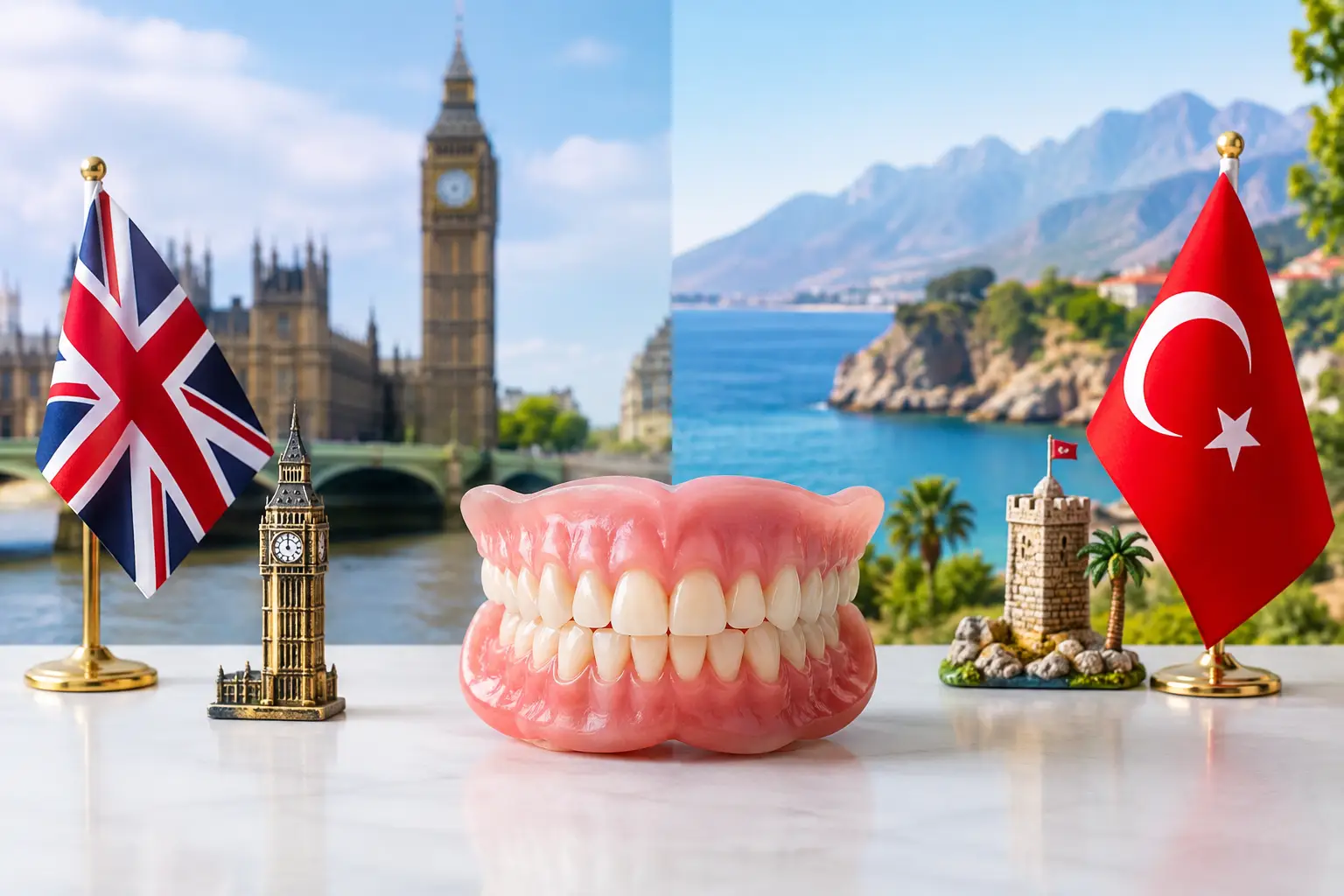
A full denture quote in the UK can easily make people consider a flight before they have even chosen a shade. That is understandable. But UK vs Turkey dentures is not a simple question of finding the lowest price. Dentures are custom medical devices that affect how you eat, speak and feel about your appearance every day. A cheap denture that rubs, moves or looks artificial is not a bargain.
I have seen Turkish clinics produce excellent, natural-looking dentures at prices well below private UK dentistry. I have also seen clinics treat dentures as an add-on to a cosmetic holiday package, with rushed impressions and no credible plan for adjustments. The difference is rarely the country. It is the clinical process, the laboratory and what happens when the first fit is not quite right.
UK vs Turkey dentures: the real cost difference
Private UK prices vary sharply by city and practice, but a conventional full acrylic denture commonly costs around £800 to £2,000 per arch. A complete upper and lower set can therefore run from roughly £1,600 to £4,000, sometimes more where extractions, immediate dentures, premium teeth or several review appointments are needed. NHS treatment may cost less for eligible patients, but the material options, timing and access can be limited, and not every patient is suitable for the route they have in mind.
In Turkey, a full acrylic denture is often quoted at around £250 to £700 per arch. A complete set may sit around £500 to £1,300. Flexible partial dentures, metal-framework partials and implant-retained overdentures cost more, as they should. If a quote is dramatically below those figures, I would ask exactly what is included before getting excited.
The lower Turkish price is largely explained by lower operating costs, staff costs and laboratory fees. It does not automatically mean weaker materials or poor dentistry. But travel is not free. Flights, hotel nights, local transfers, food, travel insurance and any return visit all belong in the real total. For a straightforward planned denture case, Turkey can still represent a meaningful saving. For a complex case needing repeated adjustments, the gap can narrow quickly.
Why dentures are harder to compare than the brochure suggests
Two clinics can both advertise “German materials” and “premium dentures”, then supply very different work. Brand names on their own tell you little. A denture’s comfort depends on accurate impressions, jaw-relation records, bite registration, tooth set-up, processing quality and careful adjustment. It also depends on whether your gums and bone are stable enough for a final denture in the first place.
I would be particularly cautious if a clinic promises a final full denture in one or two days without seeing recent clinical information. Digital scanning has improved workflow, but it has not abolished biology. If you have recently had teeth removed, your gums and jawbone will change shape during healing. A denture made immediately after extractions can be useful, but it should normally be understood as an immediate or temporary denture, likely needing relines or replacement later.
The UK model has one major practical advantage: your dentist is local when that denture creates a sore spot a fortnight later. New dentures commonly require adjustments. That is normal, not necessarily evidence of bad work. The problem with treatment abroad is not that adjustment will be needed. The problem is being hundreds or thousands of miles away when it is.
What a reputable Turkish clinic should plan for
For conventional dentures, I expect a clinic to allow enough time for assessment, impressions or scans, bite records, a wax try-in where appropriate, fitting and at least one review. A five- to seven-day stay is usually more realistic than a weekend, though the exact timeline depends on the type of denture and whether extractions are involved.
A proper consultation should cover your medical history, medications, gum condition, remaining teeth, jaw relationship and expectations. If you wear an old denture, the clinician should ask what you dislike about it. Is it loose? Does it make your face look sunken? Are the teeth too short? Do you struggle with speech? Those answers shape the design.
Before booking, ask for a written treatment plan that separates each item: examinations, X-rays or scans, extractions, temporary dentures, final dentures, relines, adjustments and sedation if relevant. I would also ask whether the clinic has its own laboratory or works with an external lab, who is responsible for the design, and how many appointments are planned. Vague answers are a red flag.
Do not let a sales coordinator make material promises that the dentist has not confirmed. Coordinators can be helpful with travel logistics, but they should not be deciding whether you need immediate dentures, a partial denture or implants.
Quality is about fit, not just teeth that look white
Acrylic dentures remain a sensible option for many people. They are repairable, relatively affordable and easy to adjust. Flexible partial dentures can look discreet because they avoid metal clasps, but they are not always the best functional choice and can be harder to adjust or repair. Metal-framework partial dentures are often stronger and more stable, although they require careful planning around your remaining teeth.
For lower full dentures in particular, expectations matter. A lower denture has less surface area to grip than an upper denture and may move during eating, especially where bone loss is significant. No clinic can honestly guarantee that a conventional lower denture will feel fixed. If stability is your main concern, two implants supporting an overdenture can be transformative, but that brings surgical costs, healing time and a more demanding travel schedule.
I would not recommend choosing implant treatment simply because a clinic says it is “better”. It may be better for the right jaw and budget. It is also more invasive, and it needs a long-term maintenance plan. Patients who travel abroad for implants should know who will examine them at home if something feels wrong.
The aftercare question most adverts avoid
A clinic’s warranty sounds reassuring, but read it carefully. A warranty can cover a fracture or manufacturing fault. It does not mean the clinic can adjust your denture remotely, cover your flight back, or take responsibility for changes in your mouth months later. Weight change, gum shrinkage and normal bone resorption can all alter fit.
Before travelling, I would want a clear answer to three questions: how many adjustments are included while I am in Turkey, what support is offered once I return home, and will the clinic provide records for a UK dentist or denture clinic? Some UK practices are understandably reluctant to take over unfamiliar work, particularly when they cannot verify the materials, design or original diagnosis. You may need to pay privately for local adjustments.
Take the fitted denture seriously during your final days in Turkey. Eat a few ordinary foods, speak at length, smile, read aloud and report any rubbing or clicking. Do not nod through the appointment because you are tired or worried about seeming difficult. A clinician cannot correct a pressure point you do not mention.
When Turkey makes sense, and when I would stay local
Turkey can make good financial sense for someone who needs planned replacement dentures, can stay long enough for a proper fitting process and accepts that local adjustment costs may arise later. It can also work well for patients combining dentures with other carefully planned dental treatment, provided the timeline is clinically realistic.
I would be more hesitant where you have painful infection, uncontrolled gum disease, a history of difficult dentures, recent extractions, complex bite issues or a medical condition that needs close follow-up. Those cases are not impossible to treat abroad, but they are poor candidates for rushed dental tourism. A local clinician who can review you repeatedly may be worth the extra cost.
The most useful question is not “Are Turkish dentures good?” Some are excellent; some are not. Ask whether this specific clinic has diagnosed your case properly, allowed enough time, named the materials and laboratory work involved, and made aftercare honest rather than decorative. If the answers are clear, Turkey may offer real value. If the pitch is all price, hotel photos and impossible timelines, keep your money and look elsewhere.