
A loose lower denture is one of the most frustrating dental problems I hear about from patients planning treatment in Turkey. It shifts when they speak, rubs the gums, and makes meals needlessly stressful. Dental implants versus dentures is not simply a question of which option looks better. It is a decision about bone health, surgery, budget, maintenance and how much stability you genuinely need.
The honest answer is that implants are usually the stronger long-term solution, but they are not automatically the right treatment for every missing tooth. A well-made denture can be a sensible, affordable choice. A badly planned implant case can be expensive, uncomfortable and difficult to put right.
Dental implants versus dentures at a glance
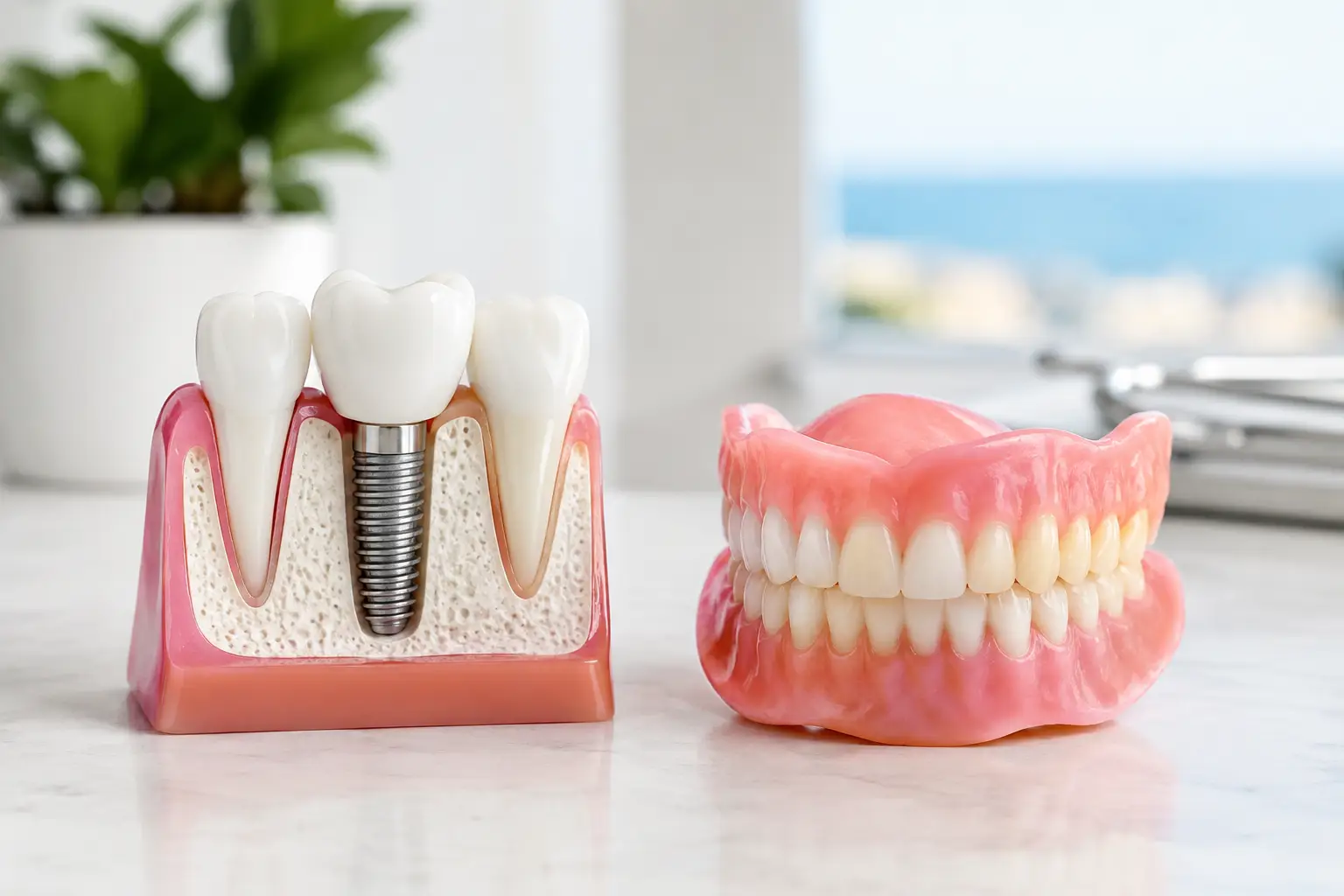
Dental implants are titanium or ceramic posts placed into the jawbone to replace tooth roots. After healing, they support a crown, bridge or full fixed arch of teeth. Because the implant is anchored in bone, it does not rely on neighbouring teeth or sit on the gum surface.
Dentures are removable replacement teeth. They may replace a few teeth or a full upper or lower arch. Conventional dentures rest on the gums and are held by their fit, suction in the upper jaw, and sometimes adhesive. Implant-retained dentures are the middle ground: a removable denture that clips onto two, four or more implants for improved stability.
That distinction matters. Comparing a full removable denture with a fixed full-arch implant bridge is not a like-for-like decision. Comparing a conventional lower denture with a two-implant overdenture is often more useful for patients who want stability without paying for a fully fixed result.
Comfort and day-to-day function
A properly integrated implant feels much closer to a natural tooth than a denture. You can chew with more confidence, speak without worrying that the teeth will move, and clean around a fixed restoration as part of a normal routine. There is still an adjustment period, particularly with full-arch work, but implants do not cover the palate in the way a traditional upper denture often does.
Dentures can look natural, but they rarely feel natural at first. The lower jaw is the difficult one because it has no palate to create suction and the tongue constantly competes for space. Even a high-quality lower denture may move slightly. That does not mean the dentist has failed; it is a limitation of anatomy.
I would not accept a clinic telling an edentulous patient that a conventional lower denture will feel just like fixed teeth. It will not. If lower-denture movement is already your main complaint, ask specifically about implant-retained options.
Bone loss is the long-term difference
After a tooth is lost, the bone that once supported its root gradually resorbs. Dentures replace visible teeth but do not stimulate the jawbone. Over years, this can change the shape of the ridge, making dentures looser and sometimes affecting facial support.
Implants transmit chewing forces into the bone, which helps preserve it around the implant site. They do not stop all natural bone change, and gum disease around implants can still cause bone loss, but they are far better than a conventional denture in this respect.
This is why delaying treatment can make an implant case more complicated. Patients who have worn dentures for many years may need bone grafting, sinus lifting in the upper jaw, or a different implant plan. None of these procedures is automatically a problem, but they add cost, healing time and clinical complexity.
Cost: the upfront price is not the whole story
Dentures cost less at the outset. In Turkey, a basic removable full denture may be priced from roughly £400 to £900 per arch, while premium materials and more complex cases cost more. Prices vary sharply by laboratory quality, dentist involvement and whether extractions, temporary dentures and adjustments are included.
A single implant with an abutment and crown commonly costs far more than one denture tooth replacement. For full-arch treatment, a removable implant-retained denture might start around £2,000 to £4,000 per arch, while fixed full-arch implant work can run from about £4,000 to £8,000 or beyond per arch. Those are broad planning ranges, not a quote.
Be suspicious of package prices that do not state the implant system, number of implants, final bridge material, scans, temporary teeth, medication and review appointments. A headline figure for all-on-four treatment can look cheap because it excludes the final zirconia bridge or assumes no grafting. That is not transparency. It is a sales funnel.
Dentures also have ongoing costs. Relines, repairs and replacement are normal as gums and bone change. Implant crowns and bridges need maintenance too, including professional hygiene visits, replacement screws or components, and occasional repairs. Implants are not maintenance-free teeth, despite what some Instagram clinics imply.
Treatment time and travelling to Turkey
Dentures can often be completed quickly, particularly once extractions have healed. Immediate dentures can be fitted on the day teeth are removed, though they usually need adjustment and may later need relining or replacement as the gums settle.
Implants take longer because biology sets the timetable. Some patients can have implants and temporary fixed teeth placed within one visit. That does not mean the final teeth are ready. The implants typically need several months to integrate before the definitive bridge or crowns are fitted.
For international patients, I generally prefer clinics that explain the case in two phases. The first visit covers scans, any extractions, implant placement and temporaries where appropriate. The second visit, often three to six months later, is for the final restoration. A clinic promising permanent full-arch teeth in a few days for every patient is oversimplifying the process.
A one-visit plan can be appropriate for a well-selected single implant case or where an existing implant is being restored. It is not a magic shortcut around healing.
Who is a good candidate for each option?
Implants suit many adults, including older patients, provided they are healthy enough for minor oral surgery and have adequate bone or an acceptable grafting plan. Controlled diabetes is not necessarily a barrier. Heavy smoking, uncontrolled diabetes, untreated gum disease and poor oral hygiene raise the risk of implant failure and need an honest discussion before treatment.
Dentures may be the better choice when surgery is medically unsuitable, finances are tight, bone grafting would make treatment disproportionately complex, or a patient simply does not want implants. There is no prize for choosing the most expensive option. The best plan is one you can maintain and afford to review.
For someone missing all lower teeth, I often see the most sensible compromise as a two-implant overdenture. It remains removable, which makes cleaning straightforward, but it is vastly more stable than a conventional lower denture. For patients who want fixed teeth and accept the higher cost and cleaning demands, four or more implants supporting a full bridge may be appropriate.
Questions I would ask before committing
Do not choose based on before-and-after photos. Ask which implant brand will be used, how many implants are planned, whether the teeth will be temporary or final, and what material the final teeth will be made from. You should also ask who performs the surgery, whether a prosthodontist is involved in the bite design, and what happens if an implant does not integrate.
For dentures, ask whether the price includes impressions, try-ins, adjustments and a future reline. A denture is not a commodity. Its fit depends heavily on the clinical records and the dental laboratory, and the cheapest option often becomes expensive after repeated remakes.
You should have a CBCT scan for implant planning, not just a panoramic X-ray. A clinic that quotes a definitive implant plan from photographs alone is guessing. I would not recommend committing a deposit until a clinician has reviewed appropriate imaging and explained the alternatives.
The choice should solve your actual problem
If you need a short-term, affordable replacement or cannot have surgery, a well-made denture is a valid treatment, not a failure. If your priority is chewing confidence, stability and preserving bone, implants are usually worth serious consideration. The sensible next step is not to chase the lowest Turkish package price, but to get a written plan that makes clear what you are receiving, what can change, and how the result will be maintained after you fly home.