
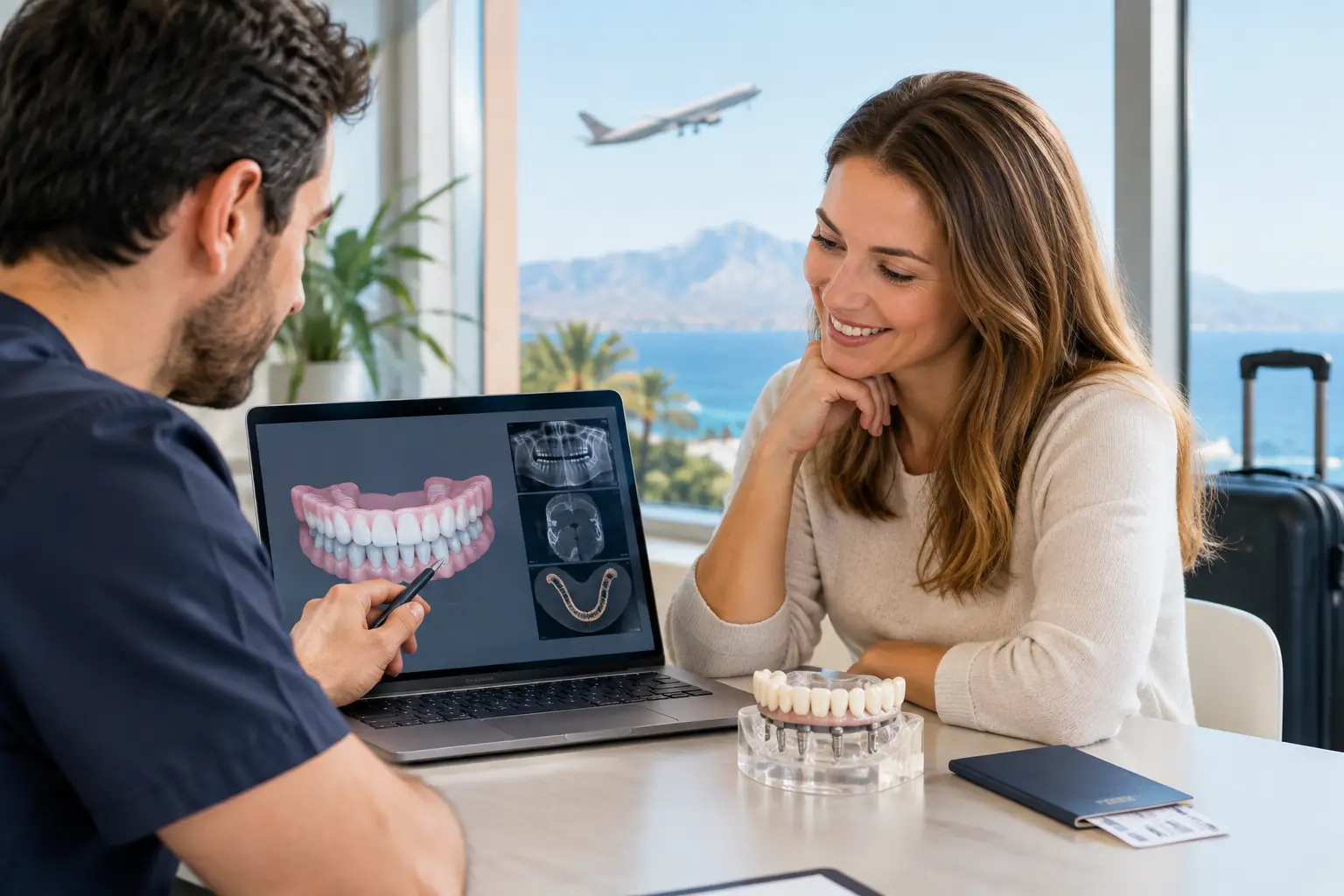
A full-mouth implant case can look deceptively simple online: remove failing teeth, place four or six implants, fit a fixed bridge, fly home smiling. Full arch treatment planning is the part that decides whether that promise is realistic or whether you are being sold a standard package before anyone has properly assessed your mouth.
I have seen too many treatment plans from Turkey built around a price point rather than a diagnosis. That is how patients end up with an unsuitable immediate bridge, unexpected bone grafting charges, or a bite that feels wrong months after treatment. The planning phase is not admin. It is the treatment.
What full arch treatment planning should establish
A proper plan answers four basic questions before surgery is booked: what teeth can genuinely be saved, how much healthy bone is available, where implants can be placed safely, and what final teeth will work with your bite, face and speech.
For a patient with a few loose or heavily restored teeth, the answer is not automatically a full arch. Keeping healthy natural teeth is usually preferable to extracting them for convenience. Conversely, where infection, advanced gum disease and repeated failed dentistry affect most of the arch, trying to patch everything up can become the expensive option. The right decision depends on prognosis, not the clinic’s most heavily advertised package.
The plan should also distinguish between the surgical phase and the final restoration. These are related, but they are not the same job. An implant surgeon can place implants very well, yet a poor prosthetic design can still leave the patient with bulky teeth, poor speech, difficult cleaning access or excessive pressure on the implants.
The records I would expect before committing
A panoramic X-ray is useful as a starting point, but it is not enough to plan a full arch properly. The clinic needs a CBCT scan to assess bone width, height, density and the location of structures such as the sinus and lower jaw nerve. Ask whether the surgeon will review the original scan files, not merely a screenshot or a brief report.
They should also assess photographs, gum condition, existing bite and, ideally, digital scans or physical impressions. For patients travelling to Turkey, some clinics request scans before the first visit and repeat them on arrival. That is sensible. What is not sensible is receiving a final implant count and a guaranteed immediate fixed bridge from two mobile phone photos.
Medical history matters more than many dental tourism adverts suggest. Smoking, uncontrolled diabetes, previous radiotherapy, medications that affect bone healing, teeth grinding and untreated gum disease can all change the plan. None necessarily rules out implants, but they may alter the number of implants, healing time, maintenance requirements or whether immediate loading is wise.
Bone volume changes the options
The lower jaw often offers denser bone and can be more straightforward. The upper jaw is less predictable, particularly when teeth have been missing for years and the sinuses have expanded. Some patients need grafting, sinus work, short implants, tilted implants or a staged approach. A clinic that claims every upper arch can be completed in one visit with the same protocol is simplifying a biological problem for marketing purposes.
That does not mean grafting is always necessary. Experienced teams can often avoid major grafting through implant position and design. But that decision has to come from the scan. I would be wary of any provider adding grafting only after you have arrived, unless the need became clear through new clinical findings and is explained with your images.
Prosthetic-led planning is where quality shows
The best teams work backwards from the proposed final teeth. They decide the ideal tooth position, smile line, lip support and bite, then place implants in positions that can support that design. This is called prosthetic-led planning, and it is far more meaningful than simply finding enough bone for four implants.
It matters particularly when the patient has lost vertical bite height. If worn or missing teeth have caused the jaws to close too far together, the clinic may need to rebuild the bite gradually. Raising it too aggressively can affect speech, muscle comfort and appearance. Keeping it too low can leave the final teeth short and the face unsupported. There is no universal setting that works for every full arch patient.
Ask to see a wax-up, digital smile design or provisional design before the final bridge is made. It need not be a Hollywood-style smile simulation. The point is to show how the teeth will sit, how much gum-coloured material may be needed, and whether the bridge will support the lips naturally.
A fixed full-arch bridge is also not automatically the best choice for everyone. It can be excellent for a patient who wants stable chewing and accepts the maintenance commitment. A removable implant-supported overdenture may be more sensible where budget, bone anatomy, cleaning ability or manual dexterity make a fixed bridge less suitable. I would not recommend choosing fixed simply because it sounds more premium.
Immediate teeth: useful, but not guaranteed
Many Turkish clinics offer teeth on the same day or within a few days. A temporary fixed bridge can be a very good option, especially for patients who are losing visible front teeth. It protects the implants, maintains appearance and lets the team test the bite before the definitive bridge.
However, immediate loading requires enough implant stability at placement, reasonable bite forces and a patient who will follow a soft-food diet. Heavy grinding, poor bone quality, active infection or low primary stability can make it a poor gamble. In those cases, a removable temporary or a delayed fixed bridge may be safer, even if it is less attractive in a sales video.
The temporary phase is not wasted time. It reveals whether you can pronounce certain sounds, whether food catches in awkward areas, and whether the bite feels balanced. A clinic that rushes to the final zirconia bridge after a few days removes its own chance to correct these issues. For complex cases, several months of healing and refinement is often the more responsible route.
Planning your visits to Turkey
For a straightforward immediate-load case, the first visit commonly covers extractions where required, implant placement and a provisional bridge. The final restoration is usually fitted after healing, often around three to six months later. Exact timing depends on jaw, bone quality, implant stability and whether grafting was needed.
Do not book non-refundable flights around a promised final bridge date until the clinical plan is confirmed. If implants do not achieve the required stability, the plan may need to change on the day. That is not necessarily a failure by the surgeon. Pretending this possibility does not exist is the real problem.
I would also clarify who handles complications once you are back in the UK or Ireland. A reputable Turkish clinic should provide a written aftercare pathway and be clear about what it covers. A warranty that sounds generous but requires you to pay for repeated flights, hotels and treatment of preventable complications is not much protection in practice.
Questions worth asking before you pay a deposit
You do not need to interrogate a clinic with technical jargon. You do need direct answers. Ask who will place the implants and who will design the bridge. Ask how many implants are proposed in each jaw and why. Ask whether the quote includes temporary teeth, final teeth, extractions, sedation, grafting contingencies and follow-up adjustments.
Also ask what material is proposed for the final restoration. Monolithic zirconia is common because it is strong, but strength is not the only consideration. Design, thickness, opposing teeth, bite and repairability matter too. A cheap bridge that cannot be cleaned properly or repaired without replacing the whole arch is not a bargain.
Most importantly, ask what would make the clinic change the plan after your CBCT assessment. A good provider can explain the limits of what they know remotely. A bad one will guarantee everything, then introduce exceptions when you are already in the chair.
Full arch treatment is a major reconstruction, not a dental holiday add-on. Take the clinic that spends time explaining uncertainty over the one that gives you the fastest yes. That caution is usually worth far more than the deposit discount.