
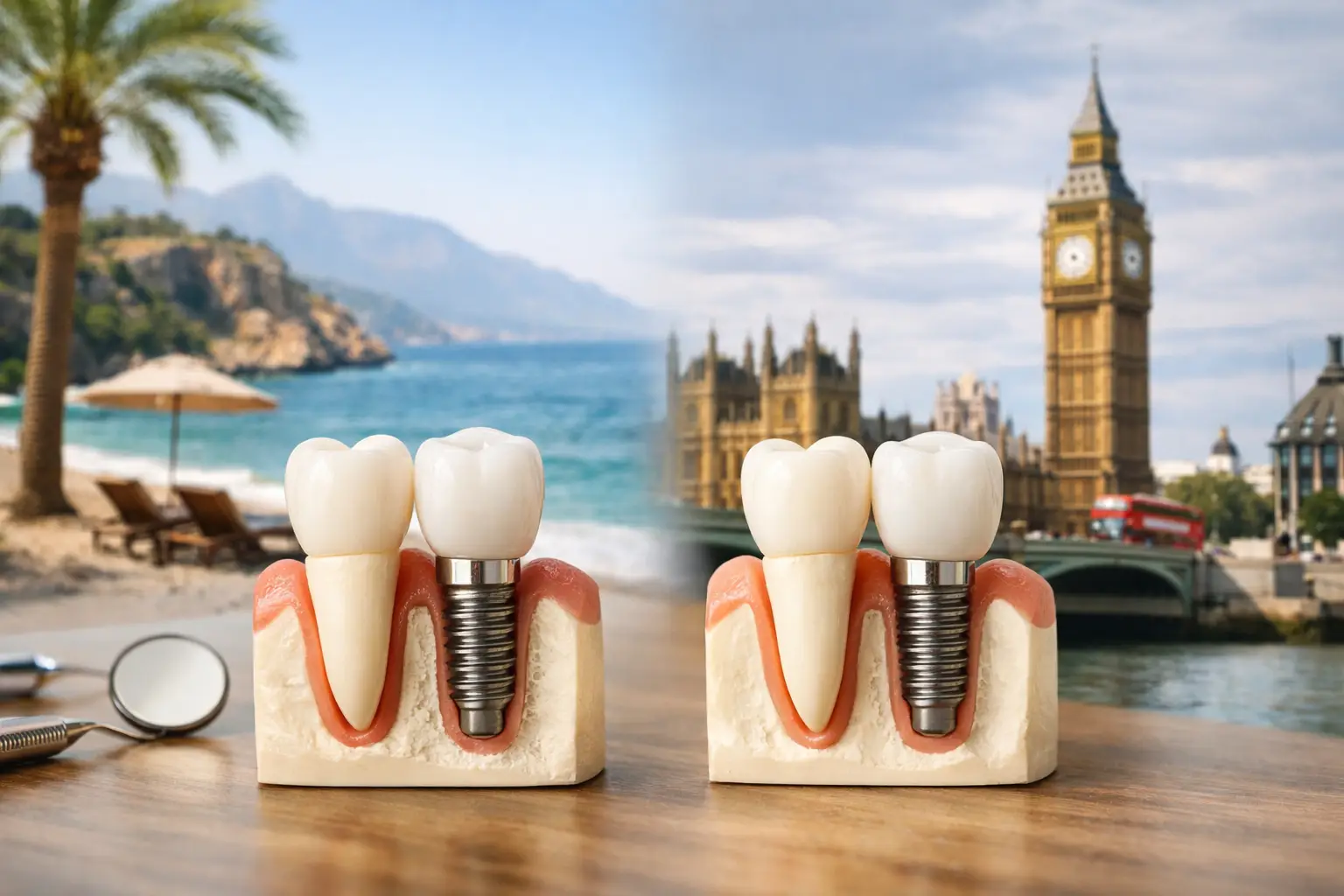
If you are comparing dental implants Turkey vs UK, you are really asking a harder question: where do I get safe, long-lasting treatment without being overcharged or rushed into the wrong plan? That is the right question, because too many clinics in both countries sell implants as if they are a commodity. They are not. The planning, the surgeon, the lab work and the follow-up matter far more than the country on the front door.
I have seen excellent implant work in Turkey and I have seen poor work in the UK. I have also seen the reverse. So if you want the blunt version, here it is: Turkey usually wins on price and speed, the UK usually wins on convenience and continuity of care, and quality can be high in either place if you choose well. The mistake is assuming one market is automatically better.
Dental implants Turkey vs UK on cost
This is the reason most people start looking in the first place. In the UK, a single implant with the implant, abutment and crown commonly lands somewhere around £2,000 to £3,500, and it can climb higher in London or with complex grafting. Full-arch treatment can move into five figures very quickly.
In Turkey, the same single-tooth treatment is often far lower, even after you add flights and a hotel. Depending on the clinic, implant brand and whether grafting is needed, you may see quotes in the rough range of £500 to £1,200 per implant fixture, with the full restored tooth costing more once the crown is included. Full-mouth or full-arch packages can look dramatically cheaper than UK private dentistry.
That price gap is real, but people often misunderstand why it exists. It is not usually because Turkish clinics are using fake materials or cutting every corner. The bigger reasons are lower operating costs, lower staff costs, a highly competitive dental tourism market and clinics built around international volume. The UK private model simply carries more overhead.
Where I would be cautious is with quotes that seem too cheap even by Turkish standards. If one clinic is far below everyone else, there is usually a reason. It might be an older implant system, outsourced lab work of mixed quality, weak diagnostics or aggressive upselling later. Cheap is not the same thing as good value.
Quality is not a country issue
The most misleading part of the dental tourism debate is the idea that UK means safe and Turkey means risky. That is lazy thinking. Good implant dentistry depends on case selection, bone assessment, surgical skill, prosthetic planning and aftercare. Those variables exist everywhere.
The UK has highly capable implant dentists and oral surgeons, but it also has general private practices offering implants with limited case complexity experience. Turkey has advanced clinics with CBCT imaging, in-house labs and surgeons doing implant work all day, every day. It also has marketing-heavy clinics that are brilliant at social media and much less impressive in treatment planning.
If I were comparing clinics, I would care less about the flag and more about these points: who places the implants, how many they place each year, what implant systems they use, whether they take a CBCT before final planning, and who designs the final teeth. Those are the details that decide whether your implants still feel stable and functional in ten years.
Regulation and standards
This is where the UK does have an advantage on paper. Regulation is familiar, complaint routes are clearer for UK residents, and there is less distance between treatment and legal accountability. If something goes wrong with a UK provider, the process is still unpleasant, but at least you are dealing with a local system.
Turkey has regulation too, but international patients often overestimate how easy it is to act on problems after they fly home. Cross-border complaints are harder. Communication can break down. Some patients discover that the warm, instant WhatsApp replies disappear once treatment is done. That is not unique to Turkey, but distance makes every problem more complicated.
This is why I tell people not to choose a Turkish clinic based on polished Instagram videos or airport transfers. Choose on clinical transparency. Ask what happens if an implant fails to integrate. Ask whether revision terms are written down. Ask how follow-up is handled from the UK. Serious clinics answer clearly. The bad ones get vague very quickly.
Treatment timelines are very different
One of Turkey’s biggest advantages is speed. In the UK, diagnostics, surgery, healing and final restoration can stretch across months of appointments, especially in busy private practices. That is clinically normal, but it can be frustrating.
Turkey is often far more streamlined for international patients. The clinic knows you are flying in, so scans, consultation and surgery may happen within a day or two. For some cases, that efficiency is helpful. For others, it creates false confidence. Fast treatment is only a benefit when the plan is sensible.
With implants, biology still sets the pace. Bone healing does not care that your return flight is on Sunday. If a clinic pushes immediate loading or full-arch treatment on every patient because it sells well, I would be sceptical. Some patients are good candidates for same-day teeth. Others are not. If everyone gets the same pitch, you are looking at a sales machine, not careful dentistry.
Materials and implant brands
This matters more than most patients realise. In both Turkey and the UK, reputable clinics tend to use recognised implant brands with a decent evidence base and international availability. That helps if you need maintenance or replacement parts later.
The problem comes when clinics use obscure systems to protect their margins. You may not notice at first, but years later your local dentist may struggle to source parts or confirm compatibility. That creates avoidable headaches.
I would always ask for the exact implant brand and model, not just “premium implant”. That phrase means nothing. I would also ask where the crowns or bridges are made, whether the lab is in-house or outsourced, and what material is being used for the final restoration. A well-made implant is part surgery, part engineering. The prosthetic side is where some cheap cases fall apart.
Aftercare is where the UK often wins
This is the most practical argument for staying local. Implants are not finished the day they are fitted. You may need bite adjustments, hygiene reviews, screw tightening, soft tissue checks or help if something feels off. Having your treating clinic nearby is useful.
With Turkey, aftercare depends heavily on the clinic’s systems and your own expectations. Some clinics provide very good remote support and schedule sensible review visits. Others treat aftercare as a vague promise. If you live in Manchester and your implant bridge needs adjustment, “just fly back to Istanbul” is not a realistic answer every time.
That does not mean Turkey is a bad choice. It means you should think beyond the headline quote. A lower upfront cost can still be excellent value, but only if the clinic has a proper aftercare structure and your local dentist is willing to handle routine maintenance.
Who should choose Turkey and who should choose the UK?
If you need multiple implants or full-arch work and UK private fees put treatment out of reach, Turkey can make genuine, high-quality care financially possible. It also suits patients who are prepared to do proper research, ask direct questions and travel twice if the case needs staged treatment. For many people, that trade-off makes sense.
If your case is complex, your medical history is messy, or you are the sort of person who wants face-to-face reassurance at every stage, the UK may be the better fit even at a higher price. The same applies if you are only replacing one tooth and the savings after travel are not dramatic. Convenience has value.
I would also separate simple marketing from clinical reality. A lot of UK patients do not need a glamorous “smile makeover” abroad. They need one or two well-planned implants placed by a clinician who is not rushing. That can happen in either country. The smart move is matching the clinic to the case, not chasing the most dramatic before-and-after photos.
The red flags I would not ignore
Some warning signs are universal. No CBCT for implant planning is a problem. Vague answers about implant brands are a problem. Pressure to commit quickly is a problem. So is any clinic that jumps to full-mouth extraction and full-arch implants without discussing whether teeth can be saved.
In Turkey specifically, I would be wary of package-first clinics where the sales team leads the process and the dentist appears late. In the UK, I would be wary of practices charging premium prices without showing equivalent implant experience. Expensive does not always mean expert.
If you are using a site like Dental Guide Turkey to shortlist clinics, use it as a filter, not a substitute for your own judgement. Ask awkward questions. Good clinics do not mind.
The right choice is not the cheapest country or the closest one. It is the place where your treatment plan makes sense, the costs are clear, and the clinic is honest about what can go wrong as well as what should go right. That is usually where the best outcomes start.