
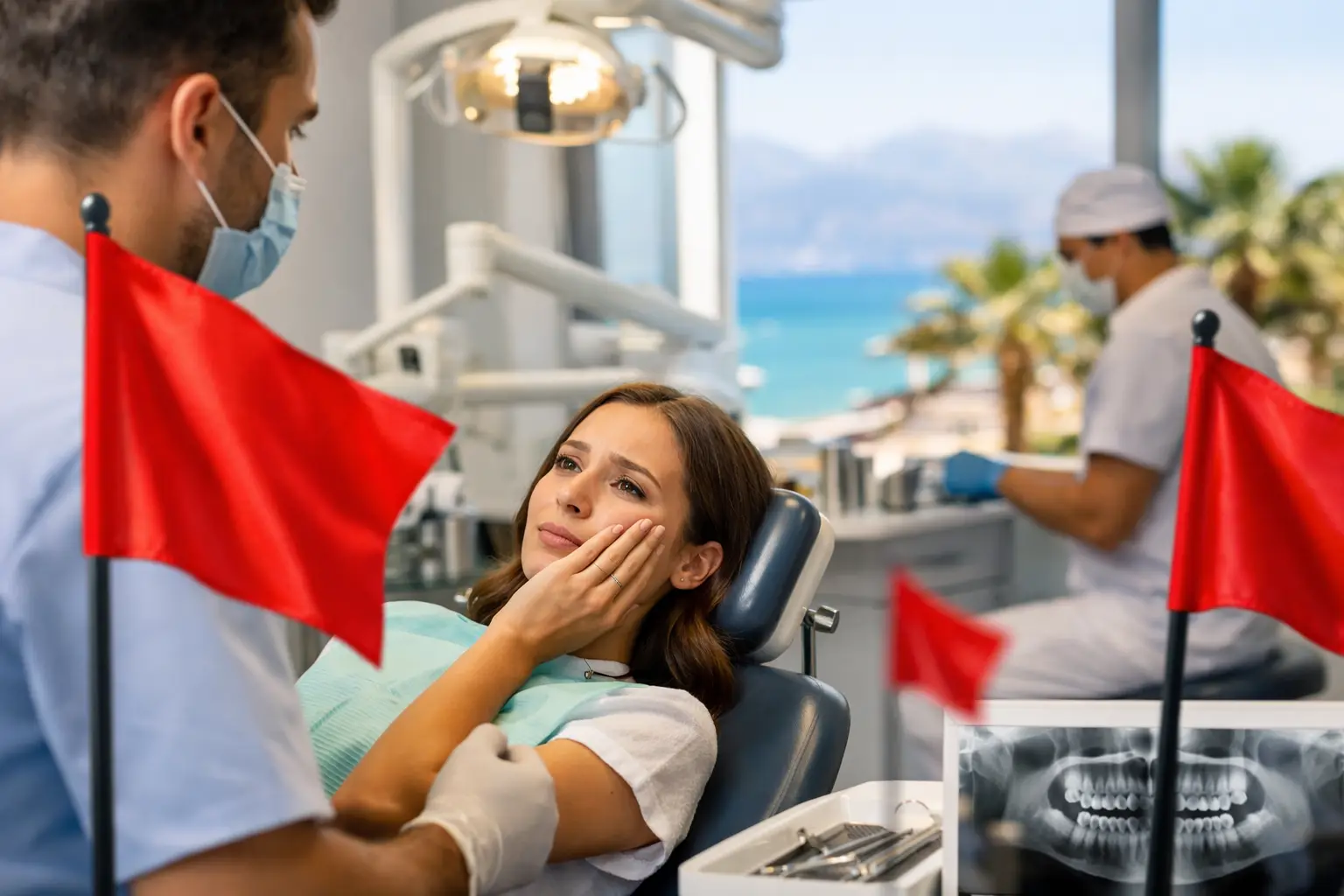
Cheap quotes can look brilliant until you realise what has been left out. When people ask me about Turkey dental clinic red flags, they are usually not worried about the obvious scams. They are worried about the polished clinics with slick sales teams, perfect Instagram grids and prices that seem just believable enough. That is exactly where patients get caught.
I have seen excellent dentistry in Turkey, and I have seen clinics I would not send anyone to. The problem is not that treatment in Turkey is inherently risky. The problem is that a fast-growing market attracts operators who know how to sell before they know how to plan treatment properly.
Why Turkey dental clinic red flags matter
If you are flying abroad for crowns, veneers, implants or full-mouth work, the risk is not just financial. Bad treatment can leave you with chronic pain, bite problems, failed implants, repeated flights back, or expensive corrective work at home. A low price stops being cheap very quickly when the case has to be redone.
That is why I always tell patients to look past the transfer service, the hotel and the before-and-after photos. The real question is whether the clinic is making sensible clinical decisions and being honest about the trade-offs.
1. They recommend treatment before proper diagnostics
This is the biggest red flag on the list. If a clinic offers a full treatment plan from a few selfies or a blurry smile photo, I would be cautious straight away.
For basic cosmetic enquiries, a rough first opinion is normal. But a definite plan for 20 crowns, multiple implants or a full smile makeover should not be made without proper diagnostics. At a minimum, that usually means recent X-rays, clear intraoral photos and a clinical assessment. For implants, a CBCT scan is often needed.
If they are certain before they have enough information, they are selling first and diagnosing later.
2. Every patient gets the same plan
When I see clinics pushing veneers or crowns as the default answer to every cosmetic concern, alarm bells ring. Some patients need orthodontics. Some need whitening and bonding. Some need gum treatment before anything cosmetic happens. Some simply do not need major work.
A good clinic explains options. A bad one funnels everyone into the most profitable package.
This matters a lot with the so-called Turkey teeth trend. If a clinic jumps straight to preparing healthy teeth for full crowns without discussing more conservative alternatives, I would question both the ethics and the long-term thinking.
3. The quote is vague or suspiciously all-inclusive
I like clear package pricing when it is genuinely clear. I do not like quotes that sound simple only because the details are hidden.
If a clinic says a treatment costs a certain amount, ask what is actually included. Does it cover consultation, scans, temporaries, sedation if needed, abutments for implants, medication, follow-up visits and any remake policy? If not, the final bill can move quickly.
The opposite problem is the unrealistically cheap all-inclusive offer. If the price is far below the market range, there is usually a reason. It might be lower-grade materials, rushed lab work, inexperienced clinicians, poor planning, or heavy upselling after arrival. I am not saying the cheapest clinic is always bad. I am saying very low prices need more scrutiny, not less.
4. They avoid naming the dentist who will treat you
This one gets missed all the time. Patients speak to an international co-ordinator, then a sales rep, then a WhatsApp account, and somehow never get a clear answer on who is actually doing the dentistry.
I would want the treating dentist’s name, their area of focus, and ideally whether one clinician is overseeing the whole case. In larger clinics, different dentists may handle surgery, prosthetics and hygiene, which can be fine. But if nobody can tell you who is responsible for the outcome, that is a problem.
A clinic should not feel like a call centre with dental chairs attached.
5. Their before-and-after photos look better than their explanations
Photos are easy to manipulate. Even when they are genuine, they do not tell you how much tooth reduction was done, whether the bite was stable, how the gums responded, or how the work looked six months later.
I pay more attention to how a clinic explains its process than how dramatic its transformations look on social media. If the marketing is all glow-ups and no discussion of materials, planning, limitations or maintenance, I assume style is doing more work than substance.
This is especially true when every result is unnaturally white, overly bulky or identical from patient to patient. Good dentistry is not copy-and-paste.
6. They pressure you to book quickly
If you hear things like today-only discounts, limited chair availability, or repeated prompts to pay a deposit before your questions are answered, slow down.
Decent clinics do get busy. That part is true. But pressure selling is still pressure selling. You should be able to ask awkward questions, compare clinics, and take time to think. If they become evasive or pushy when you ask about risks, alternatives or guarantees, I would move on.
The best clinics are rarely the ones chasing you hardest.
7. They promise impossible timelines
Turkey is good at streamlining treatment for international patients. That does not mean every case can or should be done in a few days.
Simple veneers or crowns may fit a short trip. Implant treatment often does not. Bone grafting, healing periods, gum condition and bite complexity all affect timing. If a clinic claims it can complete a complex full-mouth rehabilitation at record speed with no compromise, I would want to know exactly how.
Fast is sometimes efficient. Fast is sometimes rushed. Those are not the same thing.
8. They dismiss risks or complications
No ethical dentist tells you everything is risk-free. Veneers can chip. Crowns can fail. Implants can fail. Root canal-treated teeth can fracture. Gums can recede. Bites can need adjustment.
I do not expect a clinic to be negative. I do expect honesty. If the conversation contains only guarantees, lifetime promises and no meaningful discussion of what can go wrong, that is not reassuring. It usually means the sales process is stronger than the consent process.
9. Their communication is quick but not useful
A lot of clinics reply fast on WhatsApp. Speed is not the same as quality.
What matters is whether they answer specific questions properly. If you ask what brand of implant they use and get a generic sales line, that tells me something. If you ask why crowns are recommended over composite bonding and receive no clinical reasoning, that tells me more.
Good communication is detailed, consistent and accountable. Bad communication is friendly, vague and relentless.
10. They treat aftercare like an afterthought
This is one of the most practical Turkey dental clinic red flags because aftercare is where many overseas cases go wrong. Treatment is not finished when you leave the clinic. Adjustments, checks and occasional complications are part of reality.
Ask what happens if a crown feels high after you get home. Ask who pays if an implant restoration needs correcting. Ask whether there is any structured follow-up, not just a generic message saying to contact them if needed. If the answer is effectively good luck once you are back in Manchester, Dublin or Toronto, that is not strong enough.
I am also wary of clinics that use the word guarantee loosely. A guarantee is only meaningful if the terms are specific and realistic.
11. They make you feel silly for asking hard questions
This is the simplest test of all. Ask direct questions about the dentist, materials, risks, timeline, alternatives and what happens if something fails. A good clinic will answer professionally, even if the answer is nuanced. A weak clinic will dodge, deflect or make you feel difficult.
You are not being fussy. You are buying irreversible healthcare abroad. That should involve scrutiny.
What a good clinic usually does differently
The better clinics are not always the flashiest. In my experience, they tend to be clearer, calmer and less theatrical. They ask for proper records. They explain why a treatment is suitable and why another option may not be. They are transparent about timing, limitations and who is carrying out the work.
They also do something many poor clinics do not – they are willing to say no. If your expectations are unrealistic, if your case needs a slower plan, or if a conservative option makes more sense than a dramatic makeover, a serious clinic will tell you. That may feel less exciting in the moment, but it is usually a very good sign.
If you are comparing providers, trust the clinic that helps you think clearly, not the one that flatters you into booking. In this market, restraint is often the strongest signal of quality.