
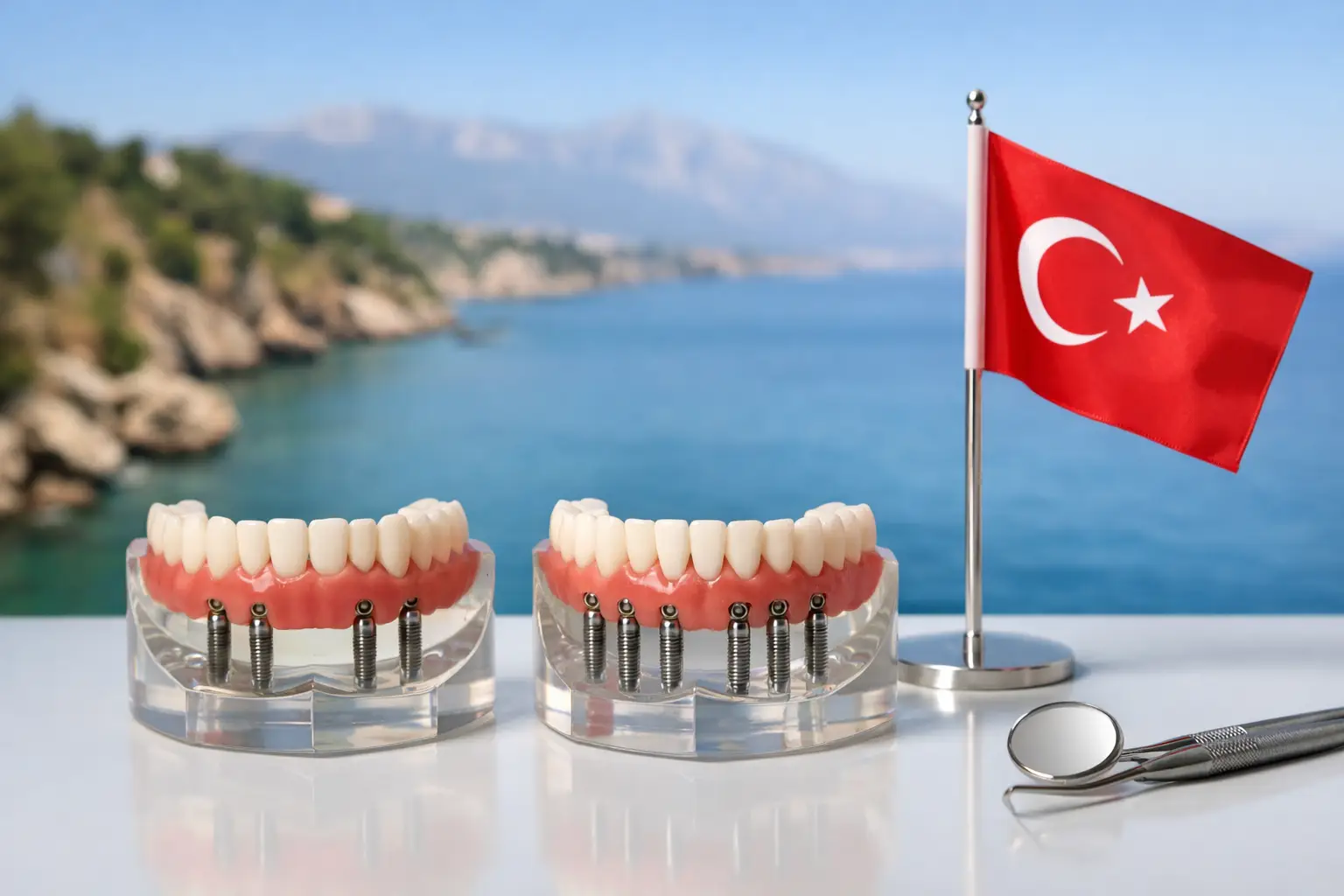
Most patients asking about Turkey all on 4 vs all on 6 are really asking a simpler question: am I being offered the right treatment, or just the one that’s easiest to sell? That matters, because both systems can work well, but they are not interchangeable, and plenty of clinics present them as if they are.
If you’re travelling to Turkey for full mouth implants, the difference is not just two extra implants. It affects how the chewing load is spread, how much bone support is needed, the design of the bridge, and sometimes how long the work lasts before major maintenance is needed. I’ve seen clinics push All on 6 as the “premium” option even when All on 4 would be clinically reasonable. I’ve also seen the opposite – clinics offering All on 4 to nearly everyone because it’s faster, cheaper, and easier to package into a slick sales process.
Turkey all on 4 vs all on 6: the quick answer
All on 4 uses four implants to support a full arch bridge. All on 6 uses six. In straightforward terms, All on 6 usually gives broader support and better load distribution, especially in the upper jaw, but it also costs more and is not automatically the better choice for every patient.
If bone volume is limited, if the anatomy makes posterior implants difficult, or if the goal is to avoid more advanced grafting, All on 4 can be a smart plan. If the patient has enough bone, stronger bite forces, a history of grinding, or wants a more conservative stress distribution across the arch, I usually see more logic in All on 6.
The problem is that many quotes in Turkey are built around what a clinic wants to sell at scale, not what your CT scan actually supports.
What actually changes between All on 4 and All on 6?
The obvious difference is implant count, but the more useful question is what those extra implants do. With six implants, the bridge has more support points. That often means less stress per implant, a more balanced spread of forces, and in some cases a more forgiving setup if one implant later develops problems.
With All on 4, the concept often relies on tilted posterior implants to maximise available bone and avoid sinus lifts or other grafting procedures. That can be a very good solution in the right mouth. It was designed to solve a real problem, not to create a cheaper Instagram package.
But it is still a more mechanically demanding setup. Four implants carrying a full arch means each implant matters more. Prosthetic design becomes more critical. Bite adjustment becomes more critical. Material choice becomes more critical. If a clinic cuts corners on any of that, the patient feels it later.
Which is better for the upper jaw?
In many cases, All on 6 makes more sense in the upper jaw. Upper bone is often softer than lower bone, and the maxilla tends to present more challenges with load and stability. Six implants can give a better support base there, especially for patients with moderate bite force, a wider arch, or parafunctional habits like clenching.
That does not mean All on 4 in the upper jaw is wrong. It can work well when planned properly. But if a clinic is recommending upper All on 4 as a one-size-fits-all treatment without a clear explanation of bone quality, implant position, and prosthetic design, I’d be cautious.
One red flag I see too often is a sales coordinator saying, “All on 4 and All on 6 are basically the same, but six is just more expensive.” That’s not a serious explanation. If that is the level of detail you’re getting before committing to surgery abroad, walk away.
Which is better for the lower jaw?
The lower jaw often has denser bone and can be more predictable for implant anchorage. Because of that, All on 4 may be a perfectly sensible option for many lower arches. In some patients, I think it’s a completely fair recommendation.
Even so, All on 6 can still be worth considering if the arch is broad, if the patient has a strong bite, or if long-term load distribution is the priority. I wouldn’t treat the lower jaw as a place where four is always enough. It depends on anatomy and forces, not just on what is cheapest.
Cost in Turkey: is All on 6 worth the extra money?
This is where the conversation usually gets distorted. In Turkey, the jump from All on 4 to All on 6 is often marketed as an upgrade. Sometimes it is. Sometimes it’s just a margin play.
As a rough guide, you’ll usually see All on 6 priced higher by the cost of two extra implants plus any added surgical and prosthetic complexity. Depending on the clinic, brand, materials, and whether temporaries are included, the difference can be meaningful but not outrageous. If a clinic is charging a massive premium for moving from four implants to six, I’d want a very clear explanation.
What matters more than the headline price is what is actually included. Some low quotes strip out essentials such as proper diagnostics, sedation, temporary bridges, or follow-up adjustments. Others quote for a hybrid acrylic bridge first, then push zirconia later as if it were an optional luxury rather than part of the real long-term cost.
I’d rather pay more for a well-planned All on 4 than less for a badly executed All on 6. Extra implants do not rescue poor planning.
When All on 4 makes more sense
There are situations where I think All on 4 is the more sensible treatment, not the inferior one. Patients with reduced posterior bone, those trying to avoid sinus grafting, and those needing a more efficient surgical approach may genuinely benefit from it.
It can also be the right call when the surgeon has strong experience with the concept and can show consistent, sensible full-arch cases – not just glossy before-and-after photos taken a week after surgery. Immediate loading protocols are common in Turkey, and All on 4 is often used in those setups because it is designed around strategic implant angulation and immediate support.
If the clinic explains the anatomical reasons clearly, shows your scan, and justifies why four implants are enough in your case, I would not dismiss it.
When All on 6 is the better call
If you have adequate bone and no strong reason to limit implant numbers, All on 6 is often the more conservative long-term option. More support points usually mean less strain on each implant and on the bridge framework. For patients who grind, have larger jaws, or want maximum stability where anatomy allows, six implants can be a better investment.
This is especially true if the final bridge is expected to last for many years with manageable maintenance rather than repeated repairs. Mechanical complications are not only about the implant itself. They can involve screws, fractures, fit, wear, and stress on the prosthesis. In that broader picture, six implants can make life easier.
Questions I’d ask any Turkish clinic
If you’re comparing Turkey all on 4 vs all on 6, don’t ask only which is better. Ask why they are recommending one over the other for your mouth. A decent clinic should be able to explain that in plain English.
Ask whether the recommendation is based on a CBCT scan or just a panoramic X-ray and photos. Ask what bone quality they expect in each arch. Ask whether posterior implants are being tilted and why. Ask what material is planned for the temporary and final bridge. Ask who designs the prosthesis and how occlusion is checked.
And ask the uncomfortable question: if I am suitable for both, what is the downside of choosing the cheaper option? If they cannot answer that properly, they probably have not thought about your case in enough detail.
The mistake patients make most often
The biggest mistake is treating implant number as the whole decision. It isn’t. The real outcome depends on diagnosis, surgical skill, implant placement, prosthetic design, material quality, and follow-up. I’ve seen mediocre All on 6 cases I would not want in my own mouth, and well-planned All on 4 cases that were entirely reasonable.
At Dental Guide Turkey, I spend a lot of time telling patients to stop being impressed by package language. “Hollywood smile” nonsense is bad enough with veneers. With full-arch implants, it can leave people with expensive problems that are much harder to fix.
If a clinic is selling certainty before it has done proper imaging, that is not confidence. It is a sales script.
The right choice between four and six implants is the one that fits your bone, your bite, your risk factors, and your budget without pretending trade-offs do not exist. If a clinic is honest about those trade-offs, you’re probably in a better place already.