
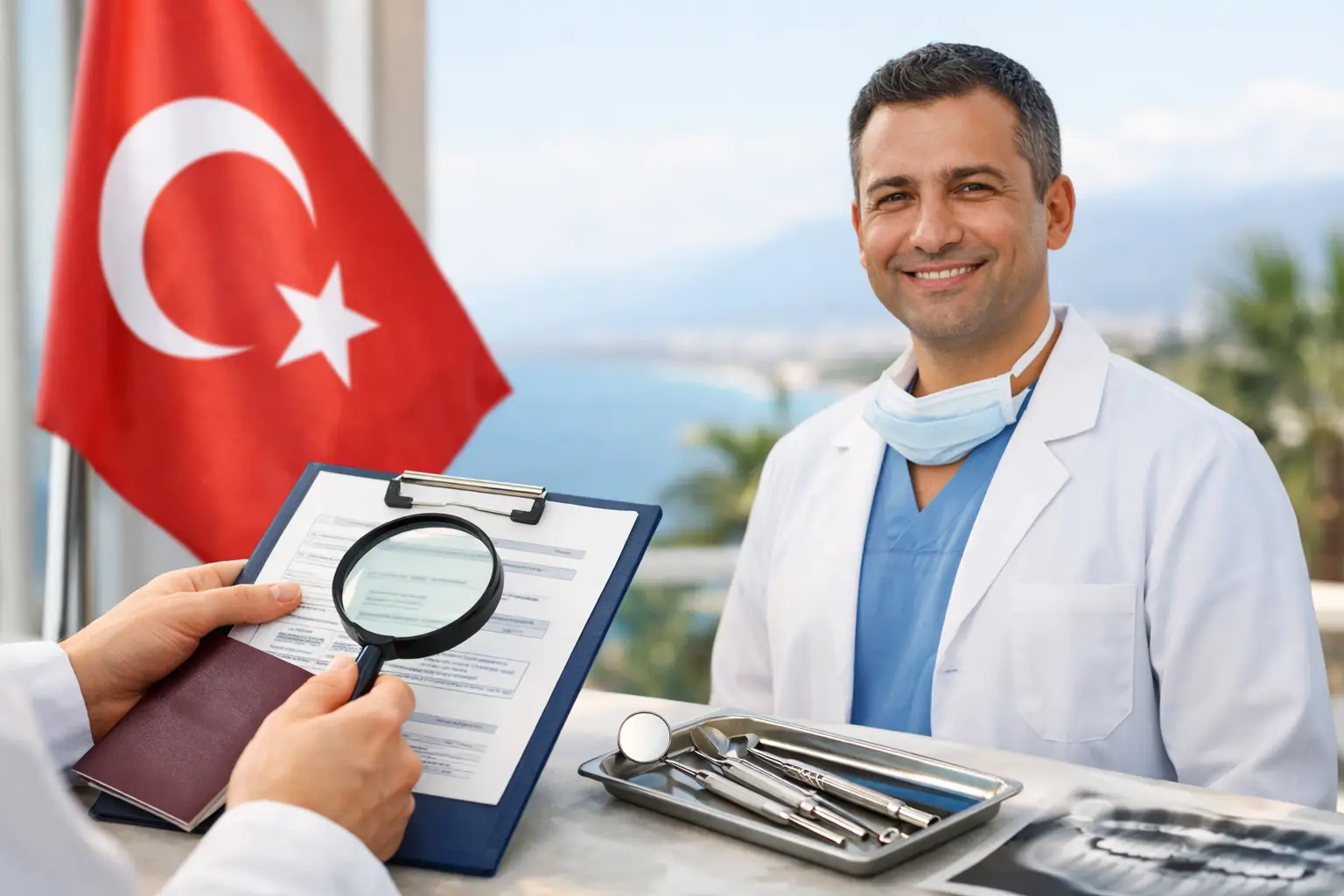
If a clinic is pushing you to pay a deposit before you have seen a dentist’s full name, licence details and actual qualifications, stop there. That is usually the moment this stops being a dental decision and turns into a sales funnel. If you are researching how to verify Turkish dentist credentials, the good news is that there are concrete checks you can make before you book flights or let anyone touch your teeth.
I have looked at enough Turkish clinic websites to say this plainly: many make qualification claims that are vague, inflated or impossible to verify from the information they give you. A polished Instagram page proves nothing. A clinic’s translator calling someone a “specialist” proves nothing. What matters is whether the dentist is legally registered, properly trained for the treatment being sold, and working in a clinic that is licensed to provide care.
How to verify Turkish dentist credentials before booking
Start with the dentist’s identity, not the clinic brand. You need the full name of the treating dentist, not just “our expert implantologist” or “our smile design team”. If a clinic will not tell you exactly who will perform your treatment, I would not recommend going any further.
Once you have the name, ask for three things in writing: their dental degree, their registration or licence status in Turkey, and any specialist training relevant to your treatment. Serious clinics can provide this quickly. Evasive ones usually send marketing copy, group photos, or certificates from short courses that look impressive but mean very little.
Turkey has a regulated healthcare system, but patients often get confused because clinic marketing uses loose language. A general dentist may have taken implant courses and place implants regularly. That does not automatically make them an oral surgeon or a recognised specialist. A cosmetic dentist title may simply be branding, not a protected specialist qualification. That distinction matters when you are considering full-mouth crowns, sinus lifts, bone grafts or complex implant work.
Check the clinic licence as well as the dentist
A registered dentist working inside a badly run or improperly represented clinic is still a risk. Ask the clinic for its Ministry of Health licence details and the legal business name under which it operates. If the clinic only trades under a catchy English-language brand name and avoids giving formal registration details, that is a red flag.
In Turkey, clinics treating international patients often market aggressively online, but the paperwork behind the brand can be less clear. I would want to know where the clinic is physically located, whether it is authorised to provide dental care, and whether the treating team actually works there full time. Some operations are essentially lead-generation brands that move patients between different providers. That is not always illegal, but it makes accountability much weaker if something goes wrong.
What qualifications actually matter
The right credential depends on the treatment. For straightforward whitening or a single filling, a licensed general dentist may be perfectly appropriate. For a full set of crowns, multiple implants, advanced oral surgery or complex bite reconstruction, I would want to see deeper training and a treatment plan led by someone with the right background.
A dental degree is the baseline. Beyond that, look for recognised postgraduate education, university affiliations that can be explained clearly, and experience in the exact procedure you need. There is a big difference between a dentist who occasionally places implants and one who does full-arch implant cases every week with documented outcomes.
This is where patients get misled. Clinics often show a wall full of certificates from weekend courses, congress attendance or sponsored brand training. Those are not worthless, but they are not the same as a formal speciality or years of supervised clinical practice. If a clinic is using course certificates to blur that line, they know exactly what they are doing.
Be careful with the word specialist
In Turkish dental tourism marketing, “specialist” gets thrown around far too casually. Ask what that means in practical terms. Is the dentist a formally trained orthodontist, periodontist, prosthodontist or oral surgeon? Or are they a general dentist with extra courses and a marketing-friendly job title?
For many treatments, a skilled general dentist may still be a sensible choice. The point is not to demand a specialist for everything. The point is to make sure the clinic is describing people honestly. If they are slippery about titles before treatment, I would not expect transparency after treatment either.
Questions I would ask any Turkish clinic
You do not need to sound confrontational. You do need to be specific. Ask who will carry out each part of your treatment, what their qualification is, and how long they have been doing that exact work. Ask whether the same dentist you speak about now will be the one treating you on the day.
Then ask for proof that matches the claim. That might include a diploma, registration information, specialist certificate where relevant, and a breakdown of who handles surgery, prosthetics and aftercare. Full-mouth cases often involve more than one clinician, which is fine. What is not fine is finding out after you arrive that the person from the video call was never going to treat you.
If the answers are vague, repetitive or over-focused on discounts, take that as useful information. Good clinics are used to serious patients asking serious questions.
How to cross-check claims without relying on marketing
First, compare the clinic’s stated credentials across different places. Do the dentist names, years of experience and speciality claims stay consistent across the website, patient materials and social media? Inconsistencies usually mean the marketing has got ahead of reality.
Second, look closely at case evidence. I am not talking about heavily edited smile photos with no context. I mean before-and-after cases that show the starting point, the treatment type, and work that looks biologically sensible. If every result is blindingly white crowns on healthy young teeth, you are looking at sales material, not evidence of sound dentistry.
Third, read reviews with a specific filter. Reviews can tell you a lot about communication, transfers and hotel quality, but those are not credentials. Look for mentions of the actual dentist’s name, whether treatment matched what was promised, and how problems were handled later. A clinic with 2,000 glowing reviews that never mention a clinician by name does not impress me much.
Red flags that should make you walk away
Some warning signs come up again and again. One is refusal to name the treating dentist until after a deposit is paid. Another is using titles like professor or specialist without saying where and how that title was earned. A third is presenting sales coordinators as if they are clinical decision-makers.
I would also be wary of clinics that promise every patient the same treatment. If everyone who sends photos is told they need 20 crowns, that is not careful diagnosis. It is a business model. The same goes for clinics that push immediate treatment plans without proper X-rays, medical history or discussion of alternatives.
It depends on the treatment you want
Credential checks should get stricter as treatment gets more invasive and harder to reverse. Veneers or crowns remove healthy tooth structure. Implants involve surgery and long-term maintenance. Full-mouth work can affect your bite, speech and jaw comfort for years. The bigger the treatment, the less room there is for vague credentials and glossy promises.
If you are considering simple work and the clinic is transparent, experienced and sensibly priced, you may not need the most decorated clinician in the country. If you are considering a major reconstruction because you have been quoted a bargain package online, I would slow down and verify everything twice.
That is especially true if the price seems far below the market. Cheap treatment in Turkey is not automatically bad, but ultra-low pricing often means corners are being cut somewhere – materials, lab quality, appointment time, staffing, aftercare, or all of the above.
A practical standard for deciding
Here is the standard I use. I want to know the treating dentist’s full name, their core qualification, what they are legally registered to practise, what advanced training is genuinely relevant, and whether the clinic itself is properly licensed. I also want treatment planning that makes clinical sense and does not feel like a package holiday add-on.
If a clinic can provide that clearly and consistently, that is a good start. If they avoid the question, change the subject or try to pressure you with limited-time offers, you have your answer. Dental Guide Turkey exists because too many patients are asked to trust branding instead of evidence.
You do not need perfect certainty before travelling for treatment. You do need enough proof to know who is treating you, what they are qualified to do, and whether the clinic is being honest about it. If a provider cannot meet that basic standard before you book, I would keep looking. Your teeth are expensive to fix twice.