
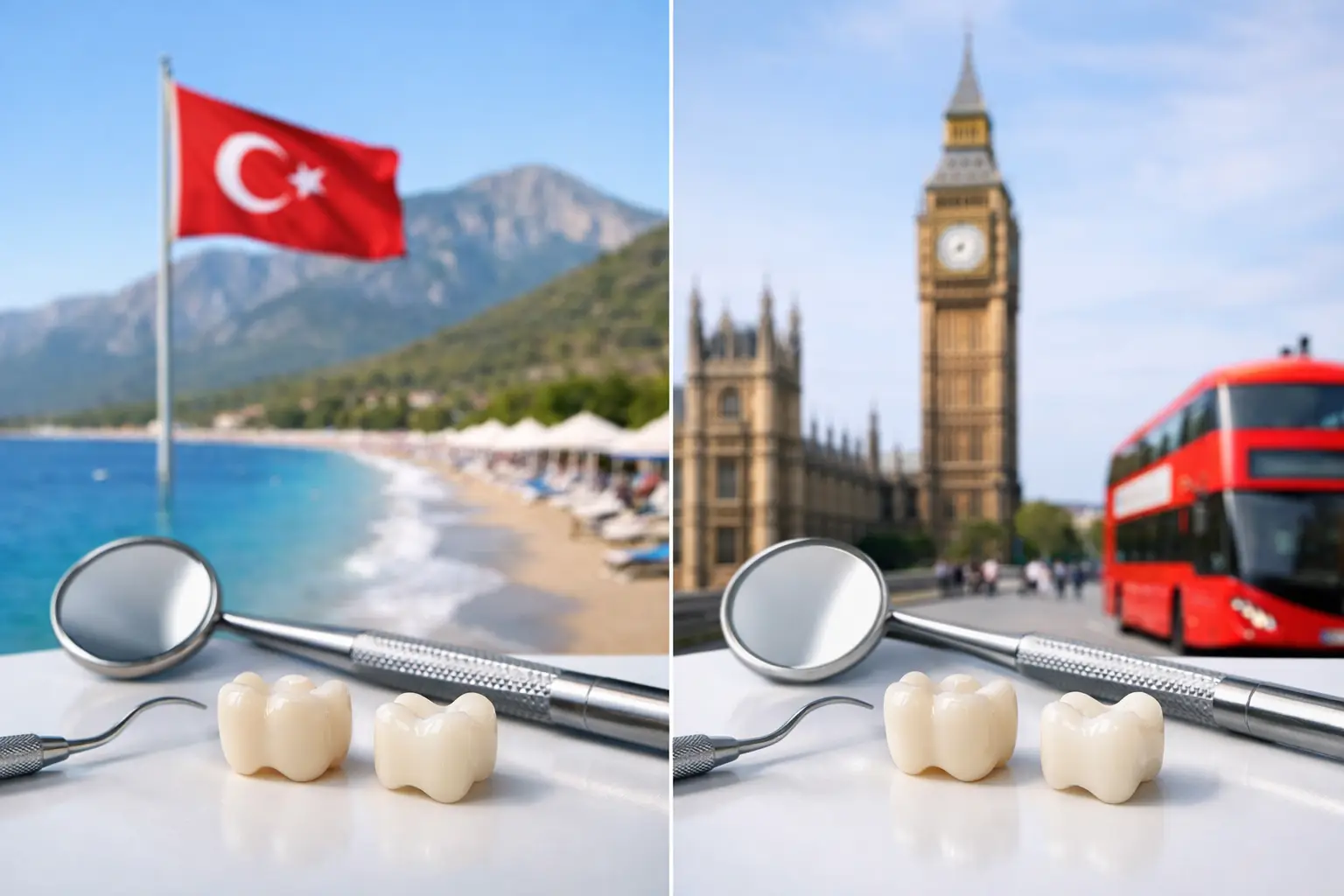
A single crown can expose the real difference between dental treatment in Britain and dental tourism. The headline price is obvious. The harder question is whether the dentist has diagnosed the tooth properly, chosen the right material and left you with a crown that still works five years later.
For patients comparing crowns Turkey or UK, my short answer is this: Turkey can offer very good value, particularly if you need several crowns and have healthy, well-assessed teeth. But it is not automatically the better deal. A poorly planned crown abroad can turn a £250 saving into an expensive problem once you are back home.
Crowns in Turkey or the UK: the real cost difference
Private crown prices in the UK commonly sit around £650 to £1,200 per tooth. In London and premium private practices, £1,000 to £1,500 is not unusual. The fee usually covers the dentist’s time, laboratory work, fitting appointments and a degree of aftercare. It does not necessarily cover future repairs, root canal treatment or replacement if the tooth fails.
In Turkey, a standard zirconia crown is often advertised at roughly £150 to £350 per tooth. E-max, which is a glass-ceramic often used for visible front teeth, may be nearer £250 to £450. These figures vary significantly by city, clinic, material brand, laboratory and whether the price is part of a package.
That gap is real, not imaginary. Turkish clinics generally have lower operating costs, dentists often complete far higher volumes of cosmetic work, and in-house or local dental laboratories can produce restorations quickly. But I would be cautious with a clinic advertising a full set of crowns at a price that barely seems to cover the materials. Something has to give, and it is usually diagnostic time, laboratory quality or both.
A fair comparison also includes travel. For one crown, flights, hotel stays and transfers can erase most of the saving. For six, 10 or 20 crowns, Turkey may remain substantially cheaper even after travel. This is why the numbers make more sense for larger treatment plans than for a single damaged molar.
| Cost factor | Turkey | UK | | — | — | — | | Typical private crown price | About £150-£450 per tooth | About £650-£1,200 per tooth | | Treatment appointments | Usually 2 visits over 4-7 days | Usually 2-3 visits over 2-4 weeks | | Travel costs | Flights and accommodation extra | Usually none | | Follow-up access | Often remote after you return | Local and straightforward |
NHS dentistry complicates the picture. Where a crown is clinically necessary, an NHS option may be available, but it is not a cosmetic service and availability is inconsistent. Material choices can also be more limited. I would not compare a private Turkish smile package with an NHS crown as if they are equivalent products.
The quality question is not really Turkey versus Britain
There are excellent and poor crown providers in both countries. Geography is a weak quality marker. The stronger indicators are diagnosis, preparation technique, laboratory standards and whether the dentist is willing to say no.
A competent clinician should examine the gums, take suitable X-rays where needed, assess the bite and explain why each tooth needs a crown. If a clinic recommends 20 crowns from a handful of heavily filtered photographs and no proper clinical records, I would walk away. That is not efficient dentistry. It is sales.
The same applies in the UK. A high price does not prove a good result, and a clinic with a glossy postcode may still overtreat. The practical advantage of a local dentist is continuity: they can review a sore tooth, adjust the bite, recement a loose crown or investigate a problem without you booking another flight.
Materials matter, but fit matters more
Zirconia is strong and widely used for back teeth and full-mouth cases. Modern multilayer zirconia can look good at the front too, although it may not have the translucency of E-max. E-max can produce beautiful front-tooth aesthetics but is not the universal answer, particularly where heavy grinding is involved.
The material name alone should not sell you. A well-made zirconia crown with conservative preparation and precise margins is preferable to a badly fitting E-max crown. Ask what material is proposed for front and back teeth, why it suits your bite, and whether the clinic can identify the laboratory and material system being used. Vague answers are a red flag.
The biggest risk: unnecessary drilling
A crown is not a reversible cosmetic treatment. To fit it, the dentist removes enamel and reshapes the tooth. On a heavily filled, cracked or root-treated tooth, that can be completely sensible. On a healthy tooth that only has minor cosmetic concerns, it deserves far more scrutiny.
This is where the phrase “Turkey teeth” has caused understandable anxiety. The issue is not that crowns are made in Turkey. The issue is aggressive treatment planning: healthy teeth filed down for a fast cosmetic transformation, sometimes with inadequate discussion of alternatives such as whitening, orthodontics, bonding or veneers.
I would be particularly wary if every tooth is being called a crown when the real goal is cosmetic uniformity. Some clinics use “crown” loosely in marketing. Ask directly how much tooth reduction is expected, whether any teeth can be left untouched, and what happens if the dentist finds decay, gum disease or a nerve problem after preparation begins.
A good plan should include a contingency. Root canal treatment, temporary restorations and additional visits may be needed if a tooth reacts badly. If the clinic promises that nothing can possibly change once you arrive, it is selling certainty it cannot honestly provide.
Timing: Turkey is faster, not always better
Most Turkish crown cases are completed in five to seven days. The first appointment usually involves examination, scans or X-rays, preparation and temporary crowns. The permanent crowns are fitted after laboratory production, then adjusted before you fly home.
That can work very well. Turkish labs are used to fast turnaround and many clinics have systems designed around international patients. Still, speed creates a trade-off. Your bite may feel fine in the chair but reveal a pressure point after several meals. In the UK, there is more time to test temporaries, let gums settle and revise the plan.
For straightforward cases, a week can be enough. For complex bite changes, severe tooth wear, active gum disease, jaw pain or a history of grinding, I would favour a slower approach. Rushing a full-mouth reconstruction into a holiday timetable is not sensible dentistry.
When Turkey is the better choice
Turkey is often the rational option for someone needing multiple medically justified crowns, who can budget for travel and who is prepared to research clinics properly. It can also suit patients who have been quoted an unaffordable private UK total but do not want to compromise on materials or clinician experience.
The key is to choose a dentist, not a package. Request a written treatment plan that states the number of crowns, tooth numbers, proposed materials, whether root canal treatment is included, the expected appointment schedule and the clinic’s policy for complications. A vague quote saying “Hollywood smile, all inclusive” tells you almost nothing useful.
You should also arrange a UK dentist for long-term check-ups before travelling, if possible. Many dentists will not guarantee or take responsibility for work completed elsewhere, which is understandable. They can still assess your gums, monitor the crowns and treat problems, but you should expect to pay privately for this care.
When I would choose the UK instead
For one or two crowns, especially on teeth with uncertain symptoms, the UK is often the more practical choice. The price difference may be smaller after travel, and immediate follow-up has real value.
I would also stay local for complicated dental histories: unstable gum disease, repeated root canal failures, significant jaw issues, very worn teeth or a major bite change. These cases need planning, reviews and sometimes several stages. A clinic abroad can manage them, but only if it is genuinely set up for complex restorative dentistry rather than high-volume cosmetic makeovers.
The cheapest crown is rarely the cheapest outcome. Choose the route that gives you a proper diagnosis, a conservative plan and someone accountable when the temporary shine has worn off. That is the standard I would use, whether the clinic is in Antalya, Manchester or anywhere else.