
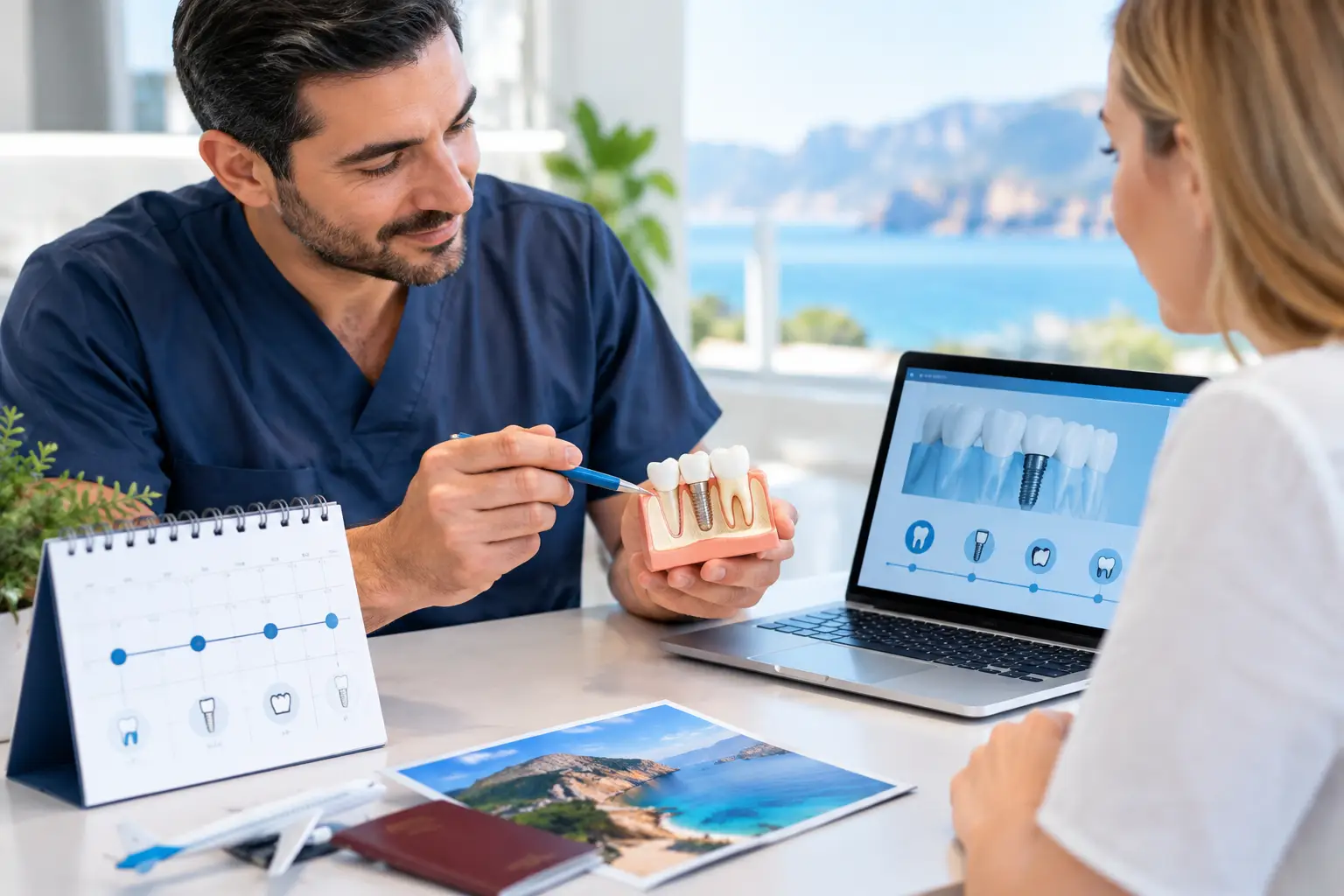
A dental implant is not a treatment I would plan around a cheap flight deal. The biggest mistake I see international patients make is assuming the implant timeline is simply: fly to Turkey, have the implant fitted, return a few days later with a finished tooth. For some straightforward cases, treatment can be efficient. But if you want to know how to plan implant timeline properly, start with biology, not the clinic’s advertised package.
The implant itself is a titanium post placed in the jawbone. It needs time to integrate with that bone before it carries the force of chewing. A good clinic can streamline appointments. It cannot safely make bone heal to a marketing deadline.
How to plan implant timeline before booking flights
I would not book either visit until a dentist has reviewed current diagnostics. At a minimum, a clinic should ask for a panoramic X-ray and clear photographs. For implant planning, a CBCT scan is usually the more useful record because it shows bone width, height and the position of nerves and sinuses in three dimensions.
Remote planning has limits. An X-ray taken a year ago may no longer reflect your situation, particularly if you have gum disease, an active infection or a recently removed tooth. The clinic should confirm the plan after examining you in person. Any provider promising an exact final treatment date from a few WhatsApp photos is selling certainty they do not have.
Your first planning question is not “How many days do I need in Turkey?” It is “What condition is the site in?” A healed gap with plenty of healthy bone follows a very different timetable from a failing tooth that needs extraction, infection control and grafting.
The three implant timelines patients actually face
Most international cases fall into one of three broad pathways. The right one depends on your bone, bite, gum health and the position of the missing tooth.
1. A straightforward healed site
If the tooth has been missing for some time, the gum is healthy and there is enough bone, the surgical phase is often completed during a first stay of around five to seven days. This allows for consultation, CBCT confirmation, implant placement and an early review before you fly home.
The usual healing period before the permanent crown is three to six months. Lower-jaw implants often integrate faster than upper-jaw implants because the bone is generally denser, but this is not a rule to rely on when arranging leave from work. You would then return for roughly five to seven days for impressions or a digital scan, crown fitting and bite adjustments.
In practical terms, I would reserve around four months between trips unless your surgeon gives a well-supported reason to shorten or extend it.
2. Extraction and immediate implant placement
Sometimes a failing tooth can be removed and an implant placed on the same day. It sounds attractive because it reduces the number of surgical appointments, and in the right case it is a valid approach. It is not automatically the best approach.
Immediate placement is more predictable when the socket walls are intact, infection is controlled, the patient does not smoke heavily and the implant can achieve good initial stability. A front tooth may also receive a temporary tooth for appearance. That temporary is not necessarily a permanent crown and should not be treated as one when eating.
Healing commonly still takes three to six months. If a clinic tells you every extraction can receive an implant immediately, I would be cautious. Some sites need time to heal precisely because forcing an implant into compromised bone creates problems later.
3. Bone grafting or a sinus lift
This is the timeline that catches people out. When bone is too thin or too low, a graft may be needed before or alongside implant placement. In the upper back jaw, a sinus lift may be required because the sinus floor sits close to the tooth roots.
Depending on the procedure and the amount of grafting, healing may add four to nine months. Sometimes the implant can be placed at the same time as a minor graft. In more extensive cases, the graft heals first and the implant is placed during a later visit. Anyone presenting a fixed two-visit, six-month package before reviewing a CBCT is simplifying a variable clinical problem.
Build time into each Turkey visit
For a routine implant surgery trip, I favour five to seven nights over a rushed long weekend. Surgery may be quick, but the treatment plan can change after the in-person scan. You also need a review appointment and a little space for swelling, discomfort or a bite issue with a temporary restoration.
For the crown visit, allow a similar window. A digital scan can be taken quickly, yet the laboratory still needs time to make the crown. The dentist should fit it, check the contact points and make sure your bite is not overloaded. That last point matters. An implant does not have the same natural shock absorption as a tooth, so a high crown can cause complications.
Do not fly home on the same day as implant surgery if you can avoid it. The issue is less about cabin pressure and more about being unavailable for an early check if bleeding, swelling or an ill-fitting temporary becomes a problem. After an uncomplicated procedure, many patients can fly after a few days, but follow the surgeon’s individual advice – especially after a sinus lift.
What can delay your implant treatment?
A respectable plan includes contingency. The following factors can lengthen the schedule or change whether an implant is sensible at all:
- untreated gum disease or poor plaque control;
- a hidden infection, cracked root or insufficient bone found on the CBCT;
- smoking, poorly controlled diabetes or medications that affect bone healing;
- teeth grinding, which may require a night guard and a more cautious loading plan;
- a temporary bridge, denture or cosmetic work needed while the implant heals.
I would also factor in the practical delay nobody mentions: remakes. If a crown shade, contour or bite is wrong, you want enough time for the lab to correct it before your return flight. Clinics that schedule your crown fit for the final afternoon are optimising their diary, not your outcome.
Ask for a written timeline, not a vague promise
Before paying a deposit, ask the clinic to set out the likely stages in writing. It should state what is included on the first visit, the expected healing range, whether temporary teeth are included, the length of the second visit and what would trigger a revised plan.
Ask who places the implant and who fits the crown. In larger dental tourism clinics these may be different clinicians, which is not inherently a problem. What matters is that the surgeon, restorative dentist and laboratory work from one agreed plan. Implant placement without a crown-led plan can leave the implant in a technically awkward position for the final tooth.
You should also ask what happens if you need a bone graft or if the implant does not integrate. No ethical clinic can guarantee osseointegration. The success rates are high in suitable cases, but high is not the same as guaranteed. Get the clinic’s policy on follow-up, remedial treatment and any additional travel costs before you commit.
A sensible calendar for most overseas patients
For a simple single implant, I would plan an initial assessment period at home, then a five-to-seven-night first trip. Allow roughly three to six months of healing, followed by a five-to-seven-night crown trip. Add breathing room around both trips rather than booking them against a wedding, major work deadline or another expensive holiday.
If extraction, grafting or a sinus lift is likely, assume the process could take six to twelve months from first visit to final crown. That can feel slow, but it is usually safer than chasing an aggressive timetable and paying for repairs later. A removable temporary or adhesive bridge is often a better short-term compromise than loading an implant before it is ready.
The best implant timeline is not the shortest one. It is the one that gives the surgeon enough diagnostic information, gives your bone enough healing time and leaves you with a realistic way to get help once you are back home.