
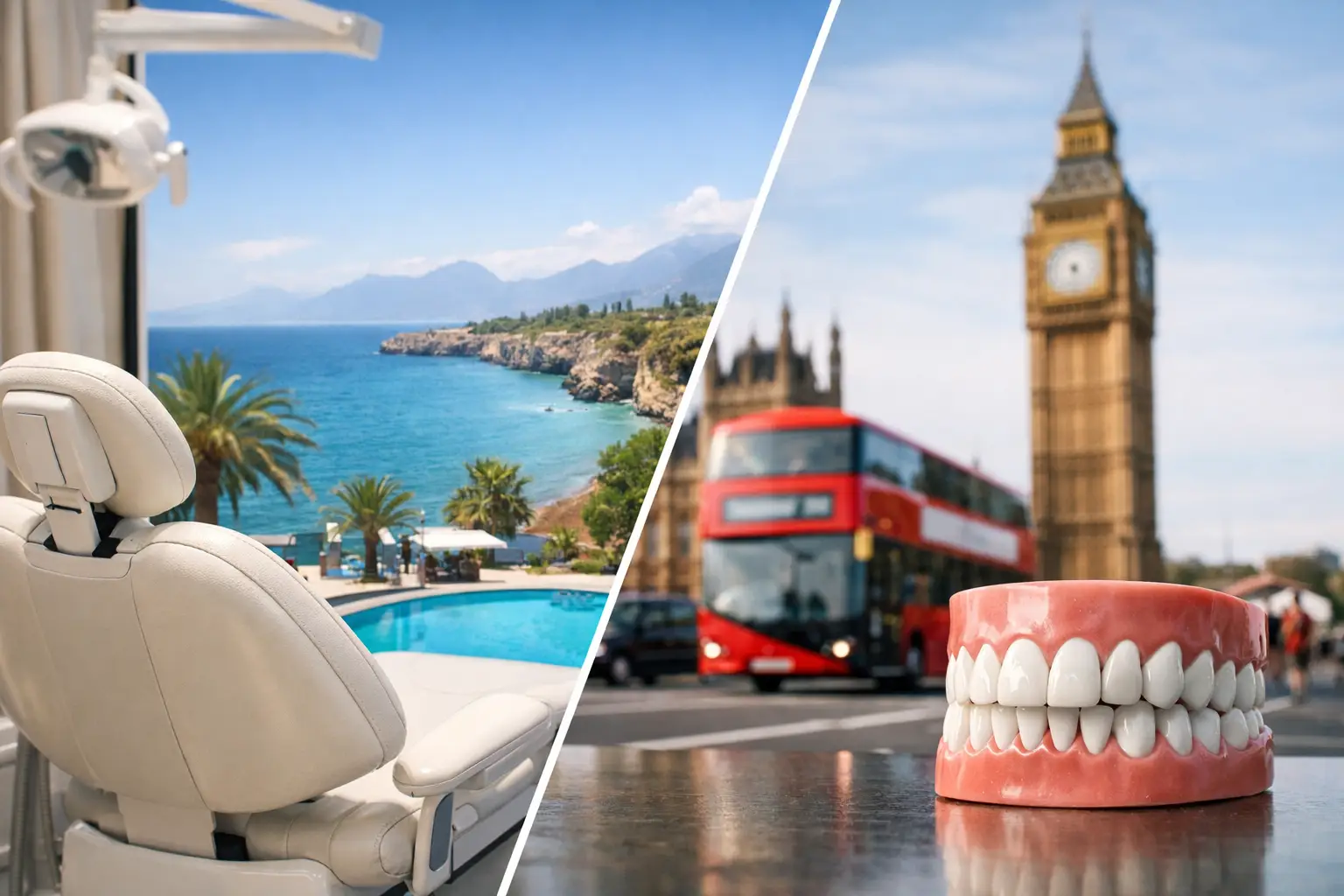
If you’re comparing Turkey vs UK veneers, you’re usually not choosing between two identical treatments at different prices. You’re choosing between two very different systems – different clinic incentives, different pricing models, different levels of tooth preparation, and very different patient journeys. That matters far more than the glossy before-and-after photos.
I’ve looked at enough veneer cases to say this plainly: the biggest mistake patients make is assuming veneers are a simple cosmetic purchase. They are not. Veneers involve irreversible changes to your teeth in many cases, and the wrong clinic can leave you with a smile that looks fake, feels bulky, or fails early.
Turkey vs UK veneers on cost
Let’s start with the obvious point. Turkey is cheaper, often dramatically so. In the UK, porcelain veneers commonly sit around £500 to £1,200 per tooth, and sometimes more in London or high-end cosmetic practices. In Turkey, you’ll see clinics advertising veneers from roughly £150 to £350 per tooth, though premium clinics can charge more.
That price gap is real, but it gets oversimplified. Lower labour costs and lower operating costs in Turkey are part of the story. So is competition. Turkish clinics market aggressively to international patients, and cosmetic dentistry is a major export service.
But cheap doesn’t always mean good value. I’ve seen clinics in Turkey quote a very low veneer price, then steer patients towards crowns on more teeth because it is faster, easier to sell as a full smile makeover, and more profitable. That is one of the biggest red flags in this market. If you ask for veneers and end up with 20 crowns on healthy teeth, you have not got a bargain – you have been overtreated.
In the UK, veneers are usually more expensive, but treatment planning is often slower and more conservative. You are also paying for higher overheads, longer consultation time in many cases, and easier legal recourse if something goes wrong. Whether that extra cost is worth it depends on your case and your risk tolerance.
Quality is not about country – it is about clinic standards
This is where most articles get lazy. They frame Turkey vs UK veneers as if one country produces better smiles by default. That is nonsense.
There are excellent cosmetic dentists in Turkey using top materials, doing very conservative prep, and producing natural-looking work. There are also poor clinics churning out bright white, over-contoured, aggressive cases for tourists who do not know what to look for. The UK has the same spread, just with fewer social media factories built around volume.
What changes by country is the structure around the treatment. In Turkey, high patient turnover is common. Many clinics are set up for speed because international patients want treatment completed within a few days. That can work for straightforward cases, but speed creates pressure. If records are rushed, mock-ups are skipped, bite issues are ignored, or temporaries are treated as an inconvenience, the final result suffers.
In the UK, treatment tends to be more staged. You are more likely to have multiple appointments, more time to review shape and shade, and easier follow-up if a veneer chips or feels wrong. That doesn’t automatically mean better dentistry, but it does create a safer environment for detailed cosmetic work.
Prep is the detail that decides whether veneers are a good idea
Most patients focus on price and shade. I focus on prep.
Some veneers need only minimal reduction. Some no-prep cases are possible. Other cases genuinely require more reshaping because of tooth position, edge length, or underlying wear. The problem is that too many clinics – in both countries, but especially in the cheap end of the Turkish market – sell “veneers” while preparing teeth like crowns.
If a clinic is shaving healthy teeth down heavily for routine cosmetic work, I would be very cautious. Veneers should preserve as much natural tooth as possible. Once enamel is gone, it is gone. That affects longevity, sensitivity, and the treatment path you are locked into for years.
A good veneer case starts with proper assessment: your bite, gum levels, tooth alignment, existing restorations, grinding habits, and what you actually want the smile to look like. If your teeth are crowded or heavily rotated, orthodontics might make more sense before veneers. If you grind at night, a protective guard is part of the discussion, not an afterthought.
Materials and lab work matter more than marketing
When clinics advertise veneers, they often throw in terms like E-max, zirconia, laminate, or Hollywood Smile as if that settles the question. It doesn’t.
For veneers, lithium disilicate materials such as E-max are commonly used because they can look very natural and work well in the right indication. Zirconia is strong, but it is not usually the first material I’d look at for ultra-natural veneers. And “laminate veneer” is often used loosely in marketing rather than as a precise clinical term.
What matters is whether the chosen material suits your case, how much prep is needed, and whether the lab work is actually good. A badly designed veneer in a premium material is still a bad veneer. Shape, translucency, surface texture, and margin fit matter. So does the dentist’s communication with the lab.
Turkey has some very capable dental labs. So does the UK. The difference is consistency. In the UK, you may have more predictable communication and easier revision processes. In Turkey, elite clinics can deliver excellent work, but lower-cost clinics may rely on speed labs producing uniform, overly white smiles because that is what many dental tourists think they want.
The real advantage of getting veneers in the UK
The biggest advantage is not that UK dentists are magically better. It is continuity.
You can have a consultation, go away and think, return for prep, wear temporaries, give feedback, refine the design, and come back if something feels off. Cosmetic dentistry benefits from that breathing room. Veneers are visible every time you speak or smile. Tiny changes in length, shape, or brightness can make the difference between natural and obviously done.
The UK also gives you simpler aftercare. If a veneer debonds, chips, irritates the gum, or your bite feels odd, you can usually get reviewed without booking flights and hotels. That matters more than people realise.
If you are an anxious patient, a perfectionist, or someone with a complex bite, I generally think the UK is the safer setting if your budget allows it.
When Turkey makes sense for veneers
Turkey makes sense when you need quality cosmetic treatment but UK prices are genuinely out of reach, and you are prepared to do proper research rather than book the clinic with the loudest Instagram page.
It can also make sense if your case is relatively straightforward, you know exactly what you want, and you choose a clinic that documents its work properly. I would want to see natural cases, not just fluorescent white smile makeovers. I would want to know who is doing the dentistry, what prep philosophy they follow, what materials they use, how many visits are needed, and what happens if adjustments are required.
A good Turkish clinic will not push you into crowns because you want a dramatic result. It will explain the trade-offs. It will discuss whether whitening, bonding, aligners, or fewer veneers could achieve the look you want with less drilling. That is the sort of conversation sensible clinics have.
Red flags I would not ignore
If a clinic promises a full set of veneers in two days with no proper planning, I would walk away. If every smile on their page is the same opaque white block shape, I would walk away. If they cannot tell you how much tooth reduction is expected, I would walk away.
The same goes for vague package deals that bundle hotel, transfers, and treatment while saying almost nothing useful about clinical planning. Travel support is fine. It should never be the main selling point.
Be especially careful with the word veneers being used to market crowns. This happens a lot. Many patients return home believing they had veneers when they actually had heavily prepared crowns on most front teeth. If you are not clear on that distinction before treatment, you are taking a serious risk.
So which is better in the Turkey vs UK veneers debate?
If your priority is lower cost and you are willing to research hard, Turkey can offer very good veneer treatment. If your priority is continuity, caution, and easy aftercare, the UK usually has the edge.
I would not say Turkey is better. I would not say the UK is better. I would say Turkey has a wider gap between the best and worst options, and patients often underestimate that. The upside is real, but so is the downside.
My honest view is simple. Do not choose a country first and a clinic second. Choose the right clinical approach first. If that happens to be in Turkey, fine. If the right answer is staying in the UK for a slower, more controlled veneer process, that is money better spent.
A good smile should still make sense five years from now, not just on the day the photos are taken.