
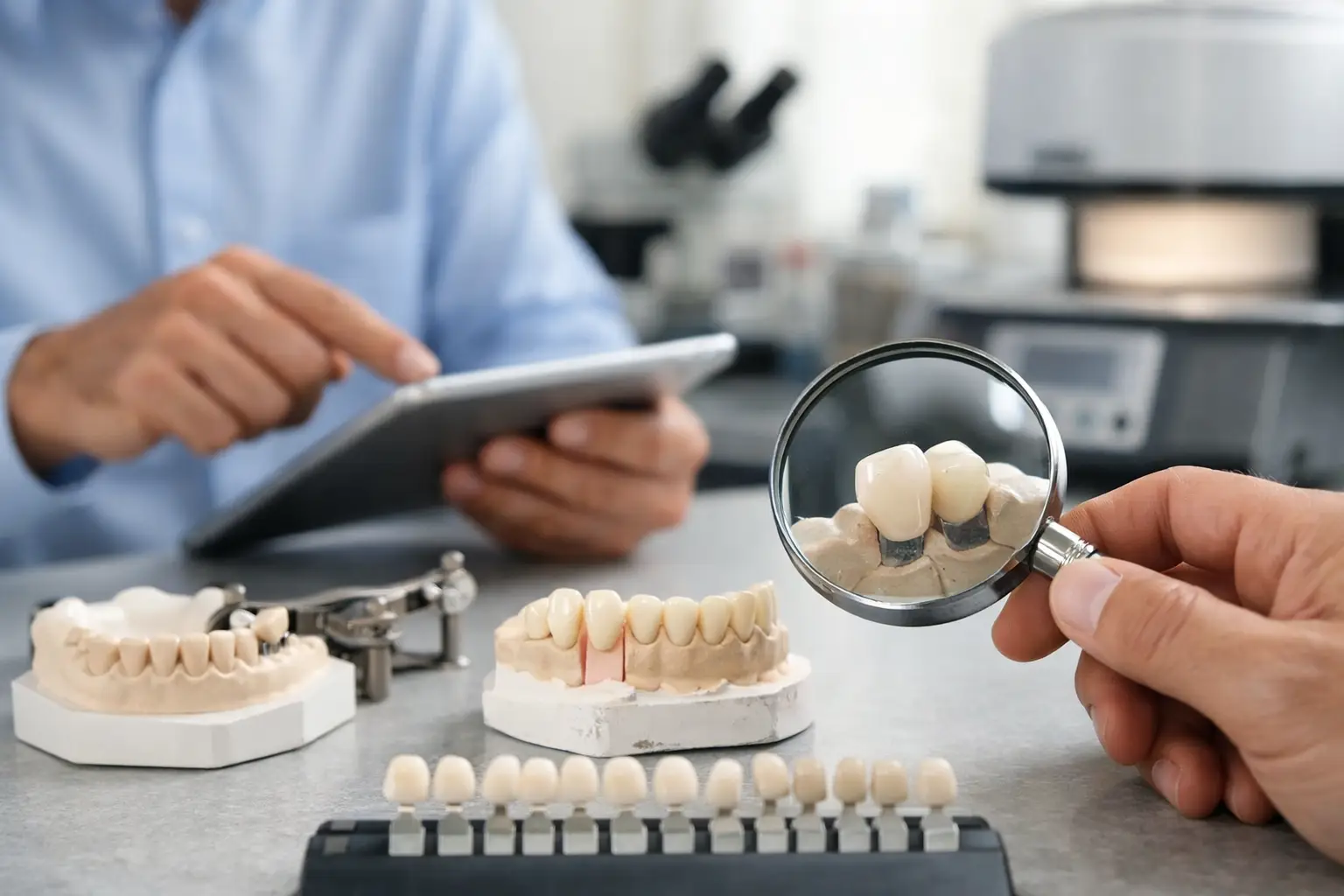
A clinic can have a polished waiting room, an English-speaking coordinator and thousands of Instagram followers, then send your crowns to the cheapest lab available. That is why knowing how to research dental lab quality matters. The dentist prepares your teeth, but the lab makes the restoration you will actually wear every day.
For patients travelling to Turkey, the problem is not that Turkish labs are inherently poor. There are excellent dental technicians and highly capable digital labs in Istanbul, Antalya and Izmir. The problem is that clinic marketing rarely tells you which lab is making your work, what materials it uses, or how the dentist and technician check the final result. I would not book a full-mouth case without getting clear answers on those points.
Why the dental lab matters more than most patients realise
A crown is not simply a white cap ordered from a catalogue. Its fit at the gumline, contact with neighbouring teeth, bite height, surface texture, translucency and shade all depend on the combination of dentist, technician and material. A poor crown can look acceptable in a filtered photo yet trap plaque, irritate gums, chip early or make chewing uncomfortable.
This is particularly relevant for veneers, zirconia crowns, implant bridges and full-mouth rehabilitation. The more teeth involved, the less room there is for careless work. A minor bite error across one crown may be adjusted in minutes. A bite error across 20 crowns can mean repeated grinding, jaw discomfort and a result that is difficult to correct once you are back in the UK or Ireland.
Do not get distracted by claims that a clinic uses a “German lab” or “European technology”. Those phrases are almost meaningless unless the clinic can name the laboratory, the materials and the process. Turkey has imported equipment, international ceramic brands and talented technicians. It also has commodity labs producing rushed work at prices that should make any patient cautious.
How to research dental lab quality before booking
Start by asking the clinic a direct question: Which laboratory will make my restorations, and can you give me its name? A reputable clinic should not treat this as confidential information. They may use an in-house lab, an external local lab, or different labs for different types of work. Any of those arrangements can work. What matters is transparency and accountability.
An in-house lab can be a real advantage for fast adjustments, shade matching and complex aesthetic cases. It can also be a problem if it exists mainly to push volume through the clinic. An external specialist lab may produce better ceramic work, especially for natural-looking veneers and implant cases, but it needs good communication with the dentist. There is no automatic winner here.
Ask what type of case the lab routinely handles. A lab that makes large volumes of standard zirconia crowns may be perfectly suitable for a straightforward back tooth. I would be more selective for front veneers, layered ceramics, smile makeovers or implant bridges, where the technician’s aesthetic judgement matters far more.
Then ask to see unedited examples of similar cases. I mean close photographs showing teeth, gums and bite, not only smiling portraits. Look for natural variation in colour, believable tooth texture and gumlines that do not appear inflamed. Every set of teeth should not look blindingly white and identical. That is often a sign of a production-line approach rather than good aesthetic dentistry.
Ask about the actual material, not just the crown type
“Zirconia” is a category, not a quality guarantee. There are major differences between low-cost opaque zirconia, multilayer zirconia and high-translucency products used in visible areas. The same applies to lithium disilicate, commonly known through the IPS e.max brand, and to ceramic layering systems.
Ask for the brand and product line proposed for your teeth. For example, a clinic should be able to explain whether it plans to use monolithic zirconia for strong posterior crowns, or a more translucent ceramic for front teeth. There is a trade-off: the strongest material is not always the most natural-looking, and the most lifelike ceramic is not always ideal for heavy grinders.
A sensible answer sounds specific and relates to your case. A weak answer is, “We use the best German material,” followed by no product name, no explanation and no paperwork.
You can also ask whether you will receive a material certificate or laboratory card after treatment. This should identify the restoration material, manufacturer and, ideally, the batch or lot details. It is useful if a future dentist needs to know what is in your mouth. Do not assume a certificate alone proves quality, though. Paperwork can be printed easily. It needs to match a credible clinical process.
Check whether the dentist and technician communicate properly
For aesthetic work, the lab should not be working from a basic impression and a shade written on a form alone. Digital scans are common in Turkey and can be very accurate, but a scanner does not replace planning.
Ask how the clinic records your bite, photographs your face and teeth, and communicates your desired shade and shape to the lab. For several front teeth or a full smile makeover, I would expect a discussion of a diagnostic wax-up or digital smile design, followed by a provisional try-in where appropriate. These are planning tools, not magic words, but they give you a chance to see the direction before final ceramics are fitted.
For complex cases, ask whether the technician can attend a shade appointment or communicate directly with the dentist during the process. This is not necessary for every single crown. It is a meaningful positive sign for demanding cosmetic work.
Look for quality control, not just fast turnaround
Many Turkish clinics advertise that a full set of crowns can be completed in five or six days. That can be realistic with an organised digital workflow. It can also be too fast for a complicated case, particularly if you need gum treatment, bite changes, implant work or several aesthetic revisions.
Ask how many fitting appointments are planned and what happens if the fit, shade or bite is wrong. A clinic that says everything will be finished immediately after one fitting is prioritising speed. I would rather see a plan that allows time for adjustments, a temporary stage where needed, and at least one proper review before you fly home.
The final fit should be checked clinically, not assumed from a computer scan. The dentist should assess margins, contacts, bite and appearance before permanently cementing restorations. If you are having multiple crowns, ask whether they will use temporary restorations or a trial smile before committing to the final work. The answer depends on the procedure, but there should be a reasoned plan.
Questions that expose weak lab arrangements
You do not need dental training to spot evasive answers. Before paying a deposit, ask these questions in writing:
- What is the full name and location of the dental laboratory making my restorations?
- Which material brand and product line are proposed for my specific case?
- Will I receive a lab card or material certificate when treatment is complete?
- Can I see close-up examples of similar work, including the gums and final bite?
- How many try-ins or fitting checks are included, and what happens if I do not approve the shade or shape?
- Who pays if a restoration fails because of a laboratory defect after I return home?
A clinic does not need to promise perfection. Dentistry cannot work that way. But it should answer clearly, explain limitations and put its warranty terms in writing. Be wary of vague lifetime guarantees. They often exclude the travel, local dentist fees and underlying issues that make a repair expensive in real life.
Red flags I would not ignore
The biggest red flag is a clinic refusing to identify its lab or material brand. The next is a package price that includes 20 or 24 crowns but no proper consultation, scan review or discussion of bite. Cheap packages have a commercial logic: if the price is low, someone in the chain is being paid very little, and it is rarely the marketing team.
I would also be cautious when every patient is offered the same treatment – identical ultra-white zirconia crowns, regardless of age, tooth condition or facial features. Good labs can make bright smiles. Good dentistry does not treat every mouth as a template.
Finally, pay attention to who answers your questions. A coordinator can be helpful with travel and scheduling, but should not be the only person explaining materials and treatment decisions. For anything beyond a simple case, request a written plan from the treating dentist. If the clinic cannot provide one before you travel, I would look elsewhere.
The best lab is not necessarily the most famous, the most expensive or the one with the flashiest CAD/CAM machine. It is the lab that is named, accountable, uses appropriate traceable materials and works closely enough with your dentist to correct problems before you board the flight home. That is the standard worth holding clinics to.