
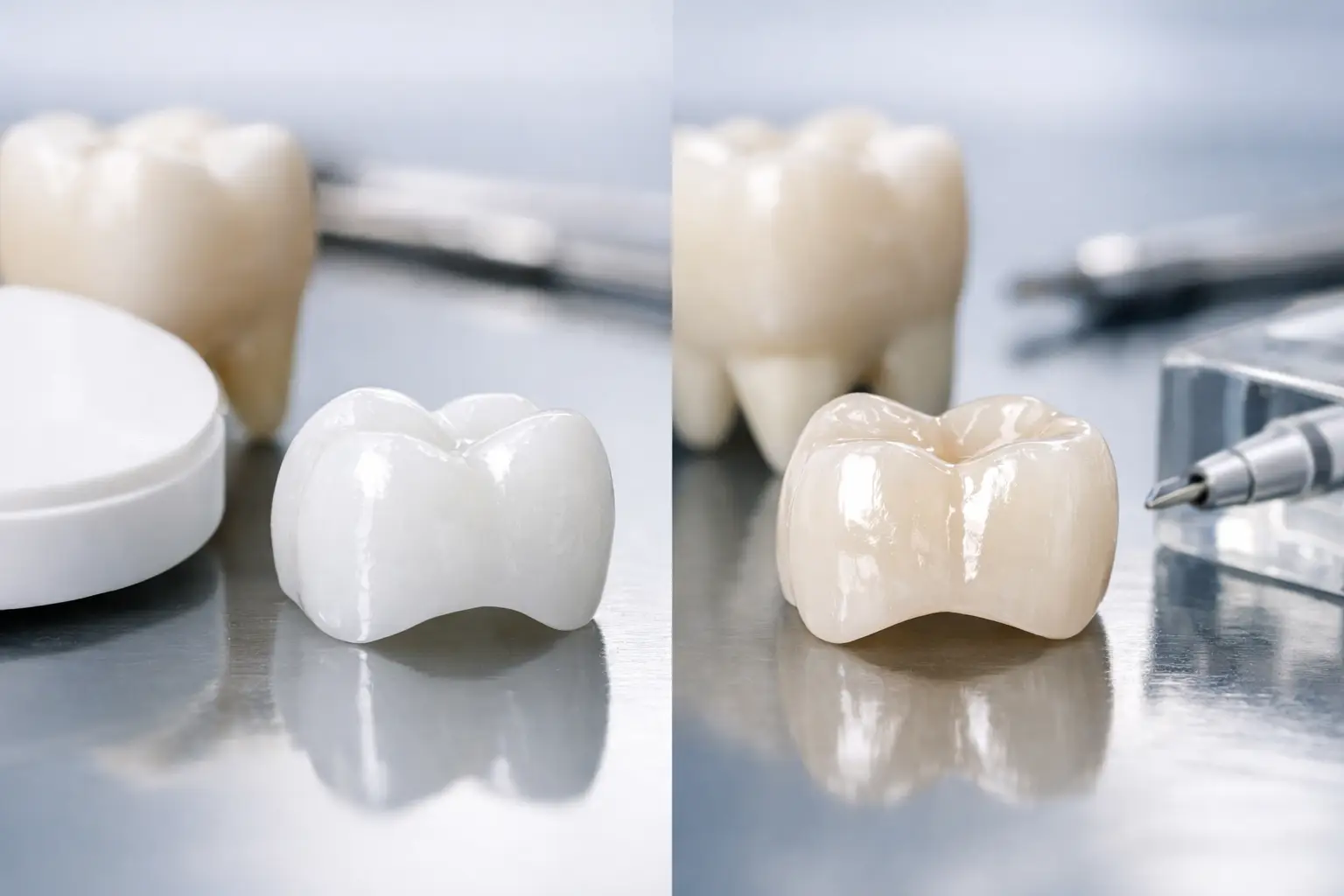
A crown quote can look simple until you ask what material is actually being fitted. Zirconia versus porcelain crowns is not a minor upgrade decision. It affects how natural the tooth looks, how it wears over time, how much tooth preparation may be needed, and whether the clinic is offering a material suited to your bite rather than the one that gives them the easiest sales pitch.
I have seen Turkish clinics use “porcelain crown” as a catch-all term for several very different products. That is a problem. A patient may think they are comparing like for like when one quote is for metal-backed porcelain, another for layered zirconia, and a third for lithium disilicate. They are not interchangeable.
The quick answer
For back teeth, heavy grinders and full-mouth crown cases, I would usually favour zirconia. It is exceptionally strong, contains no metal, and is a sensible choice where chewing forces are high. Modern high-translucency zirconia can also look very good, although it is not automatically the most lifelike option.
For a highly visible front tooth, a well-made all-ceramic porcelain crown can produce more natural depth, translucency and light reflection. But this depends on the exact ceramic used, the colour of the underlying tooth, and the dental technician’s skill. A beautiful material in a rushed laboratory is still a poor crown.
The best option is rarely decided by a clinic’s Instagram gallery. It should be based on tooth position, bite, gum health, existing restorations and how much natural tooth remains.
What clinics mean by “porcelain”
This is where many overseas patients get caught out. Porcelain is often used as a marketing word rather than a precise material description.
A porcelain-fused-to-metal crown, or PFM, has a metal framework with porcelain layered over it. It is strong and has been used for decades, but the opaque core can limit the natural appearance. A dark line may become visible at the gum over time, particularly if gums recede. I would not choose PFM for a prominent front tooth today unless there is a specific clinical reason or a strict budget constraint.
Then there are all-ceramic crowns, commonly made from lithium disilicate or similar glass ceramics. Patients may know lithium disilicate by the brand name E.max. These can be exceptionally attractive in the front of the mouth because light passes through them in a way that more closely resembles natural enamel.
Zirconia is also a ceramic, although it behaves very differently. It is much stronger than glass ceramic and more resistant to fracture. Older zirconia could look chalky or overly opaque. Better multilayer and high-translucency zirconia has improved that considerably, but material improvements do not erase the need for good design.
If a Turkish clinic simply says “porcelain”, ask for the full material name, the manufacturer, whether it is monolithic or layered, and who makes it. If they cannot answer clearly, I would treat that as a red flag.
Zirconia versus porcelain crowns for strength
Zirconia’s main advantage is durability. A monolithic zirconia crown is milled from a solid block, so there is no cosmetic porcelain layer to chip off. That makes it a practical choice for molars, bridges and patients who clench or grind their teeth.
Layered zirconia is a compromise. It has a zirconia core for strength and a porcelain layer for better aesthetics. The trade-off is that the outer porcelain can chip, especially in people with a heavy bite. This does not mean layered zirconia is bad. It means the material must be chosen with the location and bite in mind.
All-ceramic porcelain crowns are strong enough for many normal cases, including some premolars and front teeth. But I would be cautious about placing them on a patient with severe bruxism without first addressing the grinding and planning a night guard. A crown is not indestructible simply because a clinic says it has a long warranty.
The opposing teeth matter too. Zirconia is hard, but a properly polished zirconia surface is generally kinder to opposing enamel than a rough or poorly adjusted crown. Poor finishing is the real concern. A crown that feels slightly high can cause discomfort, jaw strain and unwanted wear regardless of the material.
Appearance is about more than the crown material
For a single front crown, matching a neighbouring natural tooth is one of the hardest jobs in cosmetic dentistry. Translucency, surface texture, the shade at the gum line and even tiny colour variations affect the result. In these cases, lithium disilicate often gives the technician more aesthetic control.
For a full smile makeover, zirconia can be an excellent option because the dentist can create a consistent look across multiple teeth. Still, I would push back on any plan that uses the whitest possible shade by default. An unnaturally white, flat smile is a common dental tourism giveaway. It may photograph well under clinic lights but look artificial in daylight.
There is also the issue of dark underlying teeth, metal posts or old discolouration. Zirconia’s opacity can be useful because it masks darkness more effectively than translucent ceramics. This is one reason the “best” crown material changes from case to case.
Tooth preparation and long-term biology
The crown should protect a damaged tooth, not become an excuse to cut down healthy ones. Both zirconia and porcelain crowns need enough room to achieve the correct strength and shape. How much reduction is needed varies by material, crown design and the tooth itself.
Modern zirconia can sometimes be made thinner than older ceramic systems, which may allow a more conservative preparation. But I would not accept a clinic’s claim of “no shaving” for crowns as a blanket promise. If a tooth needs a crown, it normally needs some shaping. If a healthy tooth is being aggressively prepared for a cosmetic crown, you need a clear explanation of why veneers or no treatment are not better options.
Gum health matters just as much as the crown. A crown margin placed poorly, excess cement left under the gum, or badly contoured work can create inflammation regardless of whether the crown is zirconia or porcelain. Material selection cannot rescue careless clinical work.
What should you expect to pay in Turkey?
Prices vary sharply by city, laboratory, clinic reputation and whether the quoted price includes scans, temporary crowns, root canal work and follow-up adjustments. As a broad guide, PFM crowns are often marketed from roughly £100 to £180 per tooth. Zirconia commonly falls around £130 to £250, while premium lithium disilicate crowns are often around £180 to £350.
Those figures are not a quality ranking. A £130 zirconia crown may be fair value in a well-run clinic with an in-house laboratory. It may also be a low headline price that grows once the clinic adds consultation fees, temporaries, x-rays and “required” treatment. Get a written plan that states the material and brand, tooth numbers, number of appointments, inclusions and what happens if a crown needs remaking.
I would also be sceptical of packages promising 20 crowns in a few days without a meaningful bite assessment or provisional stage. Fast treatment is possible in Turkey, especially with digital milling, but speed should not replace planning.
How I would choose between them
For a molar or someone with obvious grinding, I would normally choose monolithic zirconia, provided the shade and contour are handled properly. For a single upper front tooth beside natural teeth, I would ask whether lithium disilicate offers a better match. For several front crowns, layered zirconia or high-translucency zirconia may be sensible when strength and consistency both matter.
The key question is not “Which crown is best?” It is “Which crown is best for this tooth, this bite and this treatment plan?” A clinic that can answer that without forcing every patient into the same material is the one worth taking seriously.