
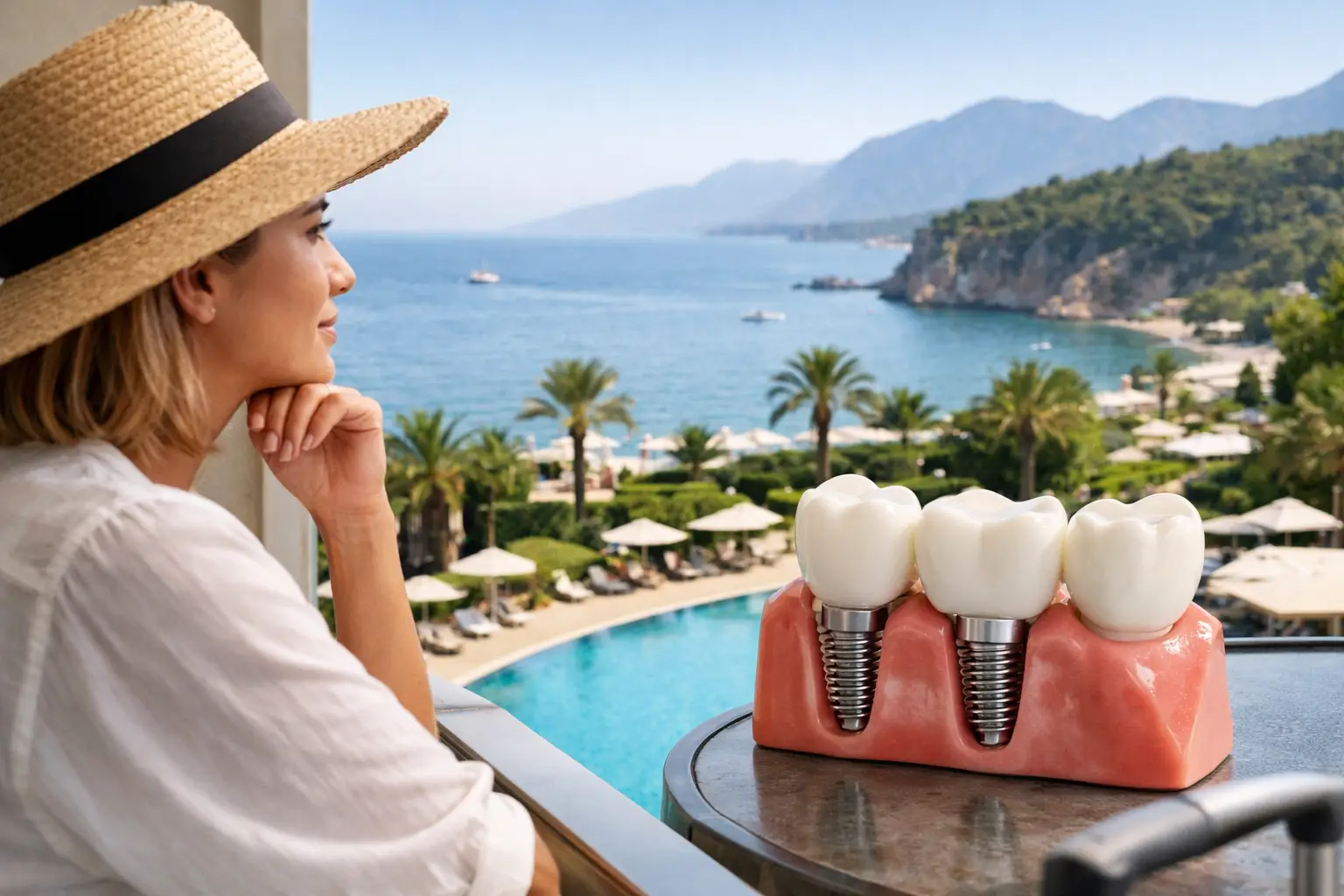
A cheap flight home the day after surgery is not a clever saving. It is how patients end up managing swelling, loose temporary teeth or a bleeding socket from a hotel room in another country. If you are asking how long to stay after implants in Turkey, my default answer is simple: allow at least seven days for implant surgery, and longer if your treatment is complex.
That does not mean everyone needs a two-week holiday. A single straightforward implant and a full-mouth reconstruction are not remotely the same thing. The honest answer depends on what is being placed, whether bone grafting is involved, how your body responds, and whether you are leaving with temporary teeth.
How long to stay after implants: the short answer
For most international patients, I would plan seven to 10 days in Turkey after dental implant surgery. This gives your dentist time to review the surgical sites, check swelling and bite, make adjustments to temporary teeth if needed, and deal with problems while you are still nearby.
For a single implant without grafting, five to seven days can be reasonable if the procedure is genuinely straightforward and you are well. For multiple implants, sinus lifts, extensive bone grafts, extraction of several teeth, or full-arch immediate-load work, 10 to 14 days is the safer plan.
I would not recommend arriving on Monday, having surgery on Tuesday and flying home on Wednesday simply because a clinic says it is possible. Technically possible is not the same as sensible. Swelling and discomfort commonly peak around days two and three. That is exactly when you want access to the treating dentist, not a generic out-of-hours service at home that has no record of your case.
Your treatment plan changes the timeline
The number of implants matters, but the surgical work around them matters more. Implants are titanium fixtures placed into the jawbone. If your bone volume is good and the gum is healthy, placement can be relatively controlled. If teeth need extracting, infection needs clearing, or bone needs rebuilding first, recovery becomes less predictable.
One or two straightforward implants
A patient having one or two implants placed in healthy bone will often be comfortable travelling after a few days. I would still build in a week. You may need a review appointment, and any temporary bridge or denture can feel very different once the anaesthetic has worn off and swelling develops.
The implant itself will usually be left to heal beneath the gum or with a small healing cap visible. You will not normally receive the final crown on this first visit. That is a crucial point that some advertisements blur.
Implants with extractions or bone grafting
Stay at least 10 days if you are having several extractions, a bone graft, a sinus lift, or treatment for infection. These procedures are not a minor add-on. They increase swelling, extend healing time and make a proper post-operative review more valuable.
A sinus lift, in particular, comes with instructions about avoiding nose blowing, forceful sneezing and pressure changes. Your surgeon should advise you individually about flying. If a clinic offers no clear guidance and tells every patient the same travel schedule, I would treat that as a red flag.
All-on-4, All-on-6 and full-mouth implant work
For full-arch treatment, I would book 10 to 14 nights. You are not just recovering from surgery. You are adapting to a fixed temporary bridge, testing your bite, learning what you can eat and often recovering after multiple extractions on the same day.
The temporary bridge needs checking before you travel. A high spot in the bite can overload an implant or make chewing miserable. It can usually be adjusted quickly in clinic, but it becomes a far bigger headache once you are back in Manchester, Dublin or Toronto.
Some Turkish clinics advertise full-mouth teeth in three days. They mean you can leave with temporary fixed teeth, not that your treatment is finished in three days. The implants still need to integrate with your jawbone, and the final bridge normally comes later.
When can you fly after implant surgery?
There is no universal rule stating that every implant patient must avoid flying for a fixed number of days. For uncomplicated surgery, many people can fly after 24 to 72 hours. But I would not arrange your trip around the earliest theoretical flight.
Flying does not usually damage a routine dental implant. The practical problem is recovery: cabin dehydration, limited access to care, pressure-related discomfort after sinus procedures, and the fact that bleeding or swelling can be harder to manage in transit. The first 48 hours are also when you should be resting, using cold packs as advised and following the medication plan.
If you have a long-haul flight, give yourself more buffer rather than less. A seven-hour journey with a tender jaw and a temporary bridge is not the moment to discover your pain relief is in your checked luggage.
The second trip: when are final crowns fitted?
Most implant treatment in Turkey takes two visits. The first is for surgery and, where appropriate, temporary teeth. The second is for the final crown, bridge or full-arch prosthesis after healing.
For the lower jaw, implant integration commonly takes around three to four months. In the upper jaw, four to six months is common because the bone is often less dense. Bone grafting may push the second visit further back. Anyone promising a permanent final bridge in a few days should explain exactly why your case qualifies for immediate loading – and put that plan in writing.
The final fitting visit is often shorter. For a single crown, allow three to five days so the clinic can take a scan or impression, manufacture the crown, fit it and make bite adjustments. For a full arch, I prefer patients to allow at least five to seven days. A high-quality final bridge may need more than one try-in, especially if speech, lip support or bite needs refining.
What should happen before you leave Turkey?
Before your return flight, you should have a clinical review, not just a receptionist asking whether you feel fine. The dentist should inspect the implant sites, check that swelling is within normal limits and assess any temporary restoration.
You should also leave with your implant passport or equivalent records. At minimum, ask for the implant brand, implant size and position, surgery date, radiographs where available, the materials used for your temporary teeth, and a clear aftercare plan. This is not paperwork for the sake of paperwork. If you need help at home years later, a local dentist cannot identify or service an unknown implant system by guessing.
Be wary of vague labels such as German implants or premium European implants. Ask for the actual manufacturer. A recognised implant system with traceable parts is worth more than a glossy clinic brochure.
Plan for recovery, not a packed holiday
I see itineraries that combine full-mouth surgery with a Bosphorus cruise, late dinners and a flight home four days later. It looks efficient on Instagram. It is poor planning.
Keep the first two or three days quiet. Choose accommodation close to the clinic, eat the soft foods your dentist recommends, avoid smoking and alcohol, and do not exercise hard while you are still bleeding or swollen. You can see Istanbul, Antalya or Izmir once you feel up to it, but leave room for changes. A competent clinic may ask you to return for an extra review. That is good care, not an inconvenience.
Contact the clinic urgently if bleeding does not settle with the instructions you were given, pain becomes worse rather than better after a few days, you develop fever, pus, spreading swelling, numbness that persists unexpectedly, or a temporary bridge becomes loose. Do not wait until you land at home to mention it.
The sensible booking rule
If you want one number to use when booking, choose seven to 10 nights for standard implant surgery in Turkey. Move to 10 to 14 nights for full-arch work, grafting, sinus lifts or multiple extractions. Then book your second visit according to your surgeon’s healing plan, rather than the clinic’s cheapest package timetable.
Dental tourism works best when travel serves the treatment, not the other way round. Give the surgery enough time, insist on a real review before departure, and you are far less likely to turn a cost-saving trip into an expensive aftercare problem at home.