
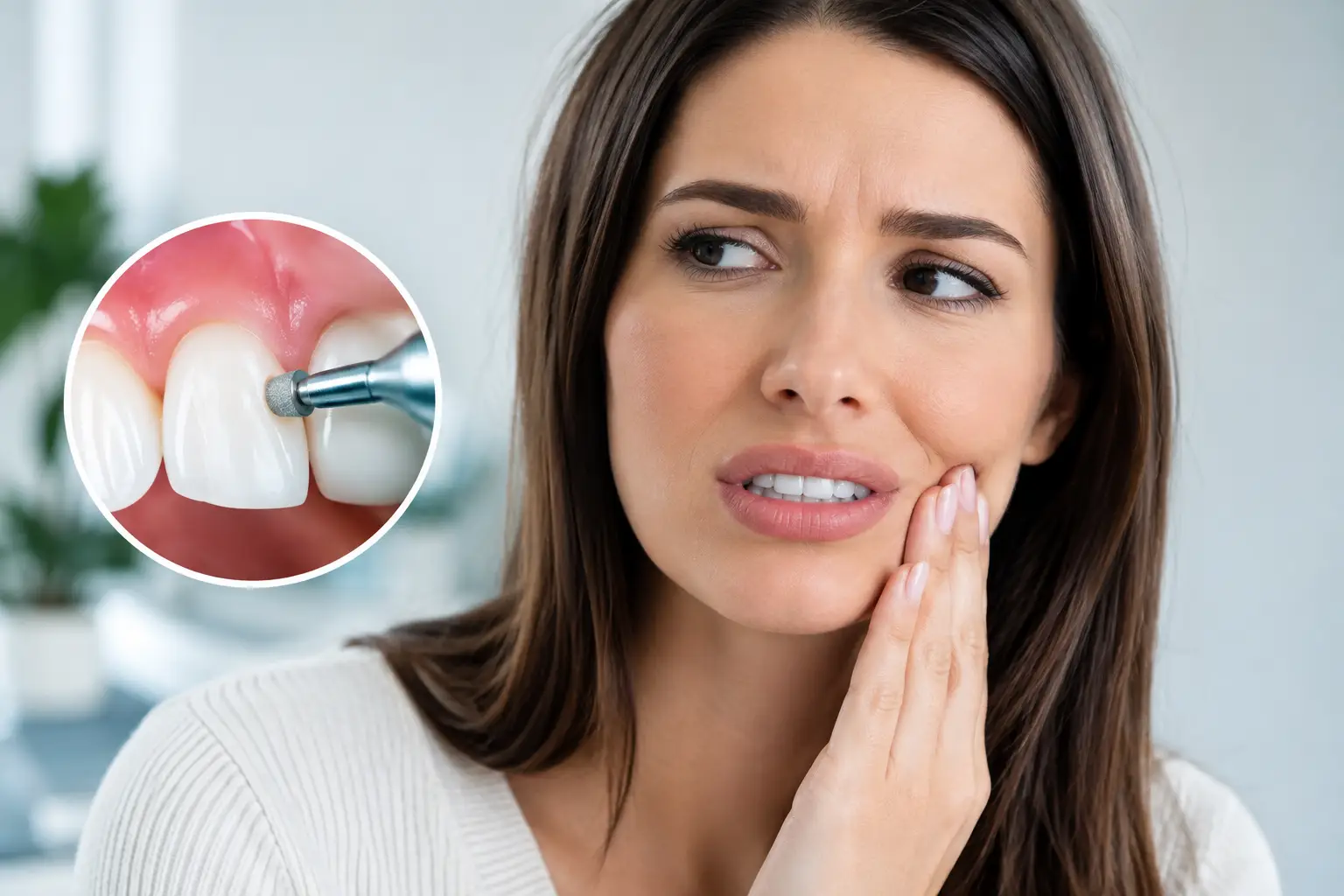
The phrase “tooth shaving” sounds casual. In dentistry, it can mean anything from polishing a tiny sharp edge to permanently removing enough enamel for a crown or veneer. What happens after tooth shaving depends entirely on which of those procedures you have had – and this is where some Turkish dental clinics are far too vague.
A small amount of contouring can be uneventful. Aggressive preparation across multiple healthy teeth is a different proposition: it is irreversible, may cause sensitivity, and commits you to restorations that will need replacing throughout your life. I would not agree to it because a sales consultant calls it a “Hollywood smile” procedure.
What happens after tooth shaving?
Immediately afterwards, the teeth can feel oddly smooth, thinner or more sensitive to cold air, drinks and pressure. How long this lasts varies. Minor enamel contouring usually settles quickly, while teeth prepared for veneers or crowns may stay sensitive until the final restorations are bonded in place.
If you have had substantial preparation, the dentist should normally fit temporary veneers or crowns before you leave the clinic. These protect the prepared teeth, reduce sensitivity and let you assess the proposed shape and bite. Do not mistake temporaries for a finished result. They can feel bulkier, pick up stains, and may occasionally come loose.
The key fact is simple: enamel does not grow back. A dentist can add composite bonding or cover a tooth with porcelain, but cannot restore natural enamel once it has been drilled away. That does not make crowns or veneers inherently wrong. They are often excellent treatments for worn, broken, heavily filled or poorly shaped teeth. It does mean the decision deserves more thought than a before-and-after photograph.
The three procedures people call “shaving”
First, there is enamel contouring, sometimes called enameloplasty. This removes a very small amount of enamel to soften a point, level a chipped edge or improve symmetry. There is often little or no recovery period, provided the adjustment is conservative.
Second is interproximal reduction, or IPR. The dentist removes a fraction of a millimetre between teeth, commonly to create space during orthodontic treatment. Your teeth may feel slightly different when flossing, but IPR should not leave visible gaps or make teeth painful. It must be planned carefully, especially where enamel is already thin.
Third is crown or veneer preparation. This is what most dental tourists mean when they ask about shaved teeth. A veneer can sometimes be minimal-prep or no-prep, but conventional veneers and crowns require varying degrees of enamel removal. Crowns generally require more reduction because the restoration covers the entire tooth.
These procedures should never be presented as interchangeable. A patient who needs edge bonding may be offered ten crowns because crowns are quicker to package and more profitable. That is a treatment-planning problem, not a cosmetic one.
Sensitivity, pain and bite changes after shaving
Mild sensitivity after conservative tooth preparation is common. The tooth has been exposed to vibration, heat and drying during treatment, and its nerve can react. Many people notice discomfort with iced water, hot tea or breathing in cold air for a few days. Desensitising toothpaste, avoiding temperature extremes and using a soft toothbrush can help.
Persistent or worsening pain is different. Throbbing, spontaneous pain, pain that keeps you awake, swelling, or a tooth that hurts sharply when you bite needs a dentist’s review. Occasionally, the pulp – the living tissue inside a tooth – does not tolerate preparation and later needs root canal treatment. This risk is higher when teeth have large old fillings, cracks, deep decay or previous trauma.
A high bite is another avoidable issue. If a new veneer or crown hits first when you close your teeth, it can make a tooth ache and place strain on the jaw. It should be adjusted promptly. Do not accept “you’ll get used to it” if your bite feels clearly uneven after the local anaesthetic has worn off.
What should happen at a reputable clinic in Turkey
For multi-tooth veneer or crown work, I expect a proper assessment before any drilling starts. That means clinical photographs, X-rays where indicated, a gum and decay check, and a discussion of alternatives. For more complex cosmetic cases, a diagnostic wax-up or digital smile design can be useful, but it is not a substitute for checking the health of the teeth underneath.
The dentist should tell you how many teeth need preparation, why each tooth needs it, what material is proposed, and whether the plan is veneers, crowns or bonding. Ask directly: “How much natural tooth structure will be removed?” If nobody can give a meaningful answer, pause.
You should also be shown the temporaries and have a chance to comment on length, shape, speech and bite before final fitting. Once ceramic work is bonded, meaningful changes are harder and more expensive.
Turkey has excellent prosthodontists and cosmetic dentists. It also has clinics built around speed, volume and social-media transformations. The country is not the deciding factor. The diagnosis, the dentist’s restraint and the laboratory quality are.
Red flags I would take seriously
I would be cautious if a clinic quotes for 20 crowns from photographs alone, promises “no shaving” while proposing full crowns, or refuses to share what will happen if a tooth needs root canal treatment during your visit. I would also avoid clinics that schedule preparation and final fitting almost back-to-back without allowing time for bite checks, gum response or laboratory corrections.
Another red flag is being pushed towards zirconia crowns for every cosmetic case. Zirconia can be an appropriate crown material, particularly where strength is needed, but it is not automatically the best answer for healthy front teeth. Material choice should follow the tooth, bite and aesthetic goal, not a standard package.
Ask who will carry out the preparation and fitting. A coordinator can translate and organise transport; they should not be the person making clinical promises. You need a named, registered dentist accountable for your plan.
Looking after shaved teeth and temporary restorations
Until your final restorations are fitted, avoid very hard or sticky foods. Do not bite into apples, crusty rolls or ice with temporary front teeth. Floss gently, and if your dentist advises it, pull the floss out sideways rather than lifting it straight up, which can dislodge a temporary crown.
After permanent veneers or crowns are fitted, brush twice daily with fluoride toothpaste and clean between the teeth every day. Restorations do not decay, but the tooth margins can. Gum disease, decay at the edge of a crown and heavy grinding are the usual reasons attractive work fails early.
If you clench or grind, ask about a night guard. This is particularly relevant after extensive cosmetic work. A custom guard is far cheaper than repeatedly repairing chipped ceramic.
Plan follow-up before travelling home. Ideally, stay long enough for the clinic to check your bite after you have eaten and spoken normally, not just while you are numb in the chair. Keep your treatment records, X-rays and details of the materials used. A UK dentist may not take over responsibility for work done abroad, but clear records make an urgent assessment much easier.
Can teeth be repaired after too much shaving?
Natural enamel cannot be put back, but the appearance and function of overprepared teeth can sometimes be improved with new restorations. That may mean replacing poorly fitting crowns, changing bulky veneers, treating inflamed gums or carrying out root canal treatment where the nerve has been damaged. These corrections are usually more complex than the original cosmetic work.
This is why “cheap veneers” are rarely cheap over a lifetime. If healthy teeth are aggressively prepared at 25, you may be maintaining crowns or veneers for decades. A good clinician factors that into the recommendation. A poor one focuses only on how the smile looks in the departure-lounge selfie.
If you are considering treatment in Turkey, do not start by asking how many teeth will be shaved. Start by asking whether shaving is necessary at all. The best cosmetic plan is often the most conservative one that still solves the problem.