
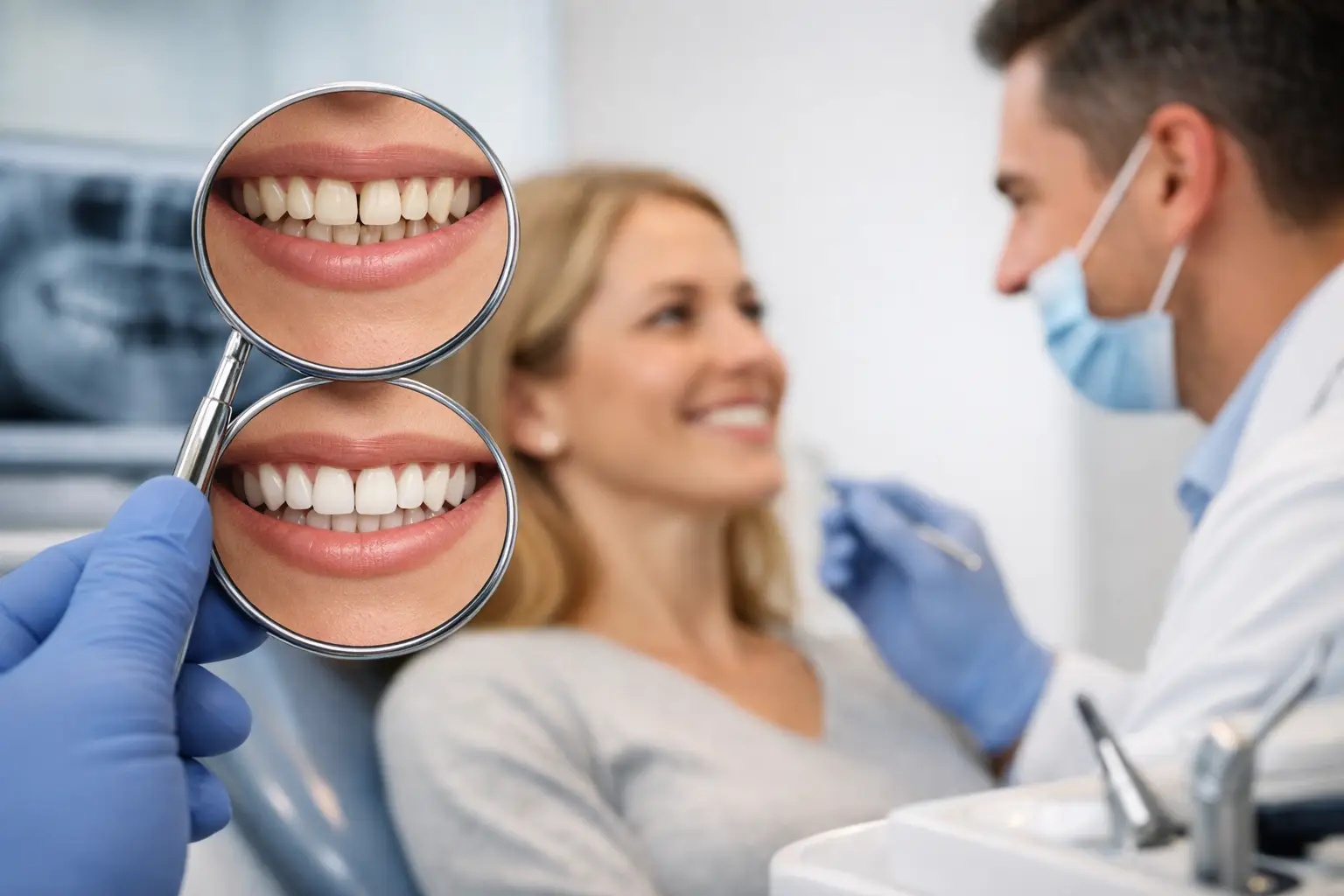
A smile can look acceptable in a filtered Instagram photo and still be a clinical mess. That is why dental revision examples matter: they show the difference between correcting a cosmetic disappointment and repairing treatment that has actively damaged teeth, gums or bite.
I see the same misunderstanding repeatedly among patients considering Turkey. They assume revision means swapping old crowns for whiter ones. Sometimes it does. More often, it means diagnosing why the first treatment failed, removing what is unsafe, and accepting that the fix may be slower, more expensive and less dramatic than the original sales pitch.
What dental revision actually means
Dental revision is corrective work carried out after previous dentistry has failed, been poorly planned, or simply no longer suits the mouth. It can involve veneers, crowns, bridges, implants, fillings, root canal treatment or full-mouth rehabilitation.
The word matters because a revision is not a standard cosmetic package. A competent dentist starts with records, X-rays and an examination of the gums and bite. If a clinic offers a price for replacing 20 crowns from a few selfies, I would treat that as a red flag. They are pricing a product, not diagnosing a patient.
Some cases need a small adjustment. Others need complete removal and a staged rebuild. The sensible treatment plan depends on how much healthy tooth remains, whether infection is present, the quality of the gum tissue and how the upper and lower teeth meet.
Dental revision examples I see most often
Crowns that are too bulky or poorly fitted
This is probably the commonest cosmetic revision case. A patient has received a set of crowns that look square, opaque or unnaturally identical. More seriously, the crown edges may sit below the gum line or have gaps where plaque accumulates. Bleeding gums, persistent bad breath and food trapping are not a normal adjustment period.
A mild shape problem may be corrected by polishing or recontouring, provided the crown is otherwise sound. Poor margins cannot be polished away. The crown normally needs removing, the tooth checked for decay, and a properly fitting replacement made.
The trade-off is unavoidable: every crown replacement can remove a little more tooth structure. This is why I would not recommend repeatedly replacing acceptable crowns just to chase a slightly different shade. Revision should solve a real problem, not feed a perfectionist cycle.
Veneers placed on teeth that needed less drilling
Some patients arrive after having healthy front teeth aggressively prepared for crowns when conservative veneers, bonding or orthodontics may have been possible. The revision goal is rarely to return those teeth to their untouched state. Once substantial enamel has been removed, that option has gone.
A good revision dentist may replace bulky crowns with slimmer, more natural restorations and improve the gum line. They should also be honest about the limits. If the underlying teeth are heavily reduced, replacement crowns may remain the most protective option. Anyone promising to reverse every previous drill mark is not being straight with you.
Pain or darkening beneath old crowns
A crown does not protect a tooth from decay or nerve problems. Leakage around an old crown can allow bacteria underneath. A tooth may become sensitive, painful on biting or darker in colour. In some cases, the tooth needs root canal treatment before a new crown is placed.
The important sequence is diagnosis first, cosmetics second. I have seen packages marketed as a quick crown replacement where the patient really required endodontic treatment and time for symptoms to settle. Rushing a final crown onto an unresolved infection is false economy.
Implant problems disguised as cosmetic issues
Implant revision is a different category entirely. A loose implant, recurrent swelling, pus, pain or visible metal should not be treated as a simple crown change. The issue could be the crown design, cement left under the gum, bone loss around the implant, poor implant position or a failing implant itself.
Sometimes the implant crown can be redesigned to make cleaning easier and improve the smile line. If there is significant bone loss or the implant is incorrectly angled, removal may be necessary. That can involve healing time, bone grafting and a delayed replacement implant. It is not the glamorous part of dental tourism, but it is the reality patients need before committing.
A bite that feels wrong after a full set of crowns
Patients often describe this as, “My teeth are too big,” or “I cannot find a comfortable bite.” Those comments should be taken seriously. New crowns that are too high can create jaw discomfort, headaches, tooth sensitivity or chipping in the opposing teeth.
Minor high spots can be adjusted. A full-mouth bite problem cannot always be solved with ten minutes of grinding. Excessive adjustment can thin ceramic and weaken it. When the jaw position and tooth lengths were never properly planned, remaking selected crowns, or occasionally the whole case, may be the safer answer.
When a partial repair makes sense
Not every disappointing result needs a complete redo. I would be cautious of any clinic that defaults to removing every crown because it creates a larger invoice. Retaining sound work is usually kinder to your teeth and your budget.
A partial revision can be reasonable where the gums are healthy, margins are sealed, the bite is stable and only one or two restorations have a clear problem. For example, a mismatched front crown may be remade to match the surrounding teeth, or a single chipped veneer may be replaced without touching the rest.
The difficulty is colour matching. Natural teeth and older ceramics change differently over time. Replacing one front restoration can be technically harder than replacing several. A skilled ceramist can often manage it, but no ethical dentist should guarantee a perfect match before seeing you in person.
What a proper assessment in Turkey should include
For complex dental revision, I would expect more than a quick chairside look. At minimum, the dentist should take current X-rays, assess gum health, examine the bite and photograph the existing work. A CBCT scan may be justified for implant concerns, suspected fractures or complex root problems. It should not be sold as an automatic add-on for every cosmetic case.
Ask the clinic to explain which teeth are restorable, which restorations can remain, and why each proposed replacement is necessary. Ask whether they expect root canal treatment, gum treatment, temporary crowns or a return visit. These are not awkward questions. They are the questions that separate a clinical plan from a sales package.
You should also ask who is responsible if the plan changes after old crowns are removed. Hidden decay is common and cannot always be predicted from photographs. The issue is not that extra treatment may be needed. The issue is whether the clinic explains the likely scenarios and costs before you are sitting in the chair.
Timing matters more than patients expect
A straightforward crown revision may fit into one Turkey trip, usually around five to eight days if no major complications arise. Root canal treatment, gum healing, implant removal or bone grafting changes the timetable completely. You may need temporary restorations and a second visit months later.
This is where cheap headline prices become misleading. A full correction after failed dentistry may cost more than the original work because it includes removal, diagnostics, temporaries, specialist treatment and new restorations. That does not automatically make it overpriced. What matters is whether the plan is clinically justified and itemised.
I would avoid clinics that promise a full revision in three days before reviewing scans. Fast can be appropriate for a simple case. Fast is dangerous when infection, unstable gums or implant complications are involved.
How to judge revision before-and-after photos
Before-and-after images are useful only if you know what you are looking at. A brighter, straighter final photo tells you almost nothing about fit, gum health or bite. Look for photos taken from close range that show the gum margins, not just a wide smile. Ideally, the clinic should be willing to explain the original problem and the clinical steps used to correct it.
Be wary of identical white blocks across every patient, heavily filtered images, and cases presented without any mention of healing or temporary work. The best dental revision examples are not always the most dramatic. Often, they are the ones where the final teeth look believable, the gums are calm and the patient has kept as much natural tooth as possible.
If you are travelling for a revision, choose the team for diagnostic discipline rather than their social media output. The right outcome may be a smaller change, a longer plan or an inconvenient second trip. That is still far better than paying twice for a smile that was never properly planned.